

 View larger
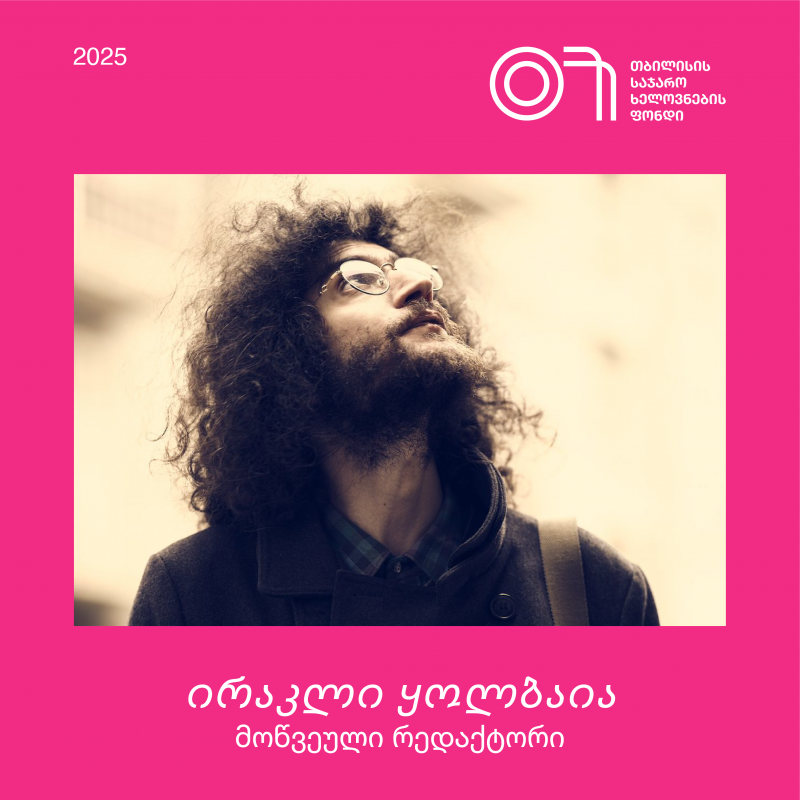
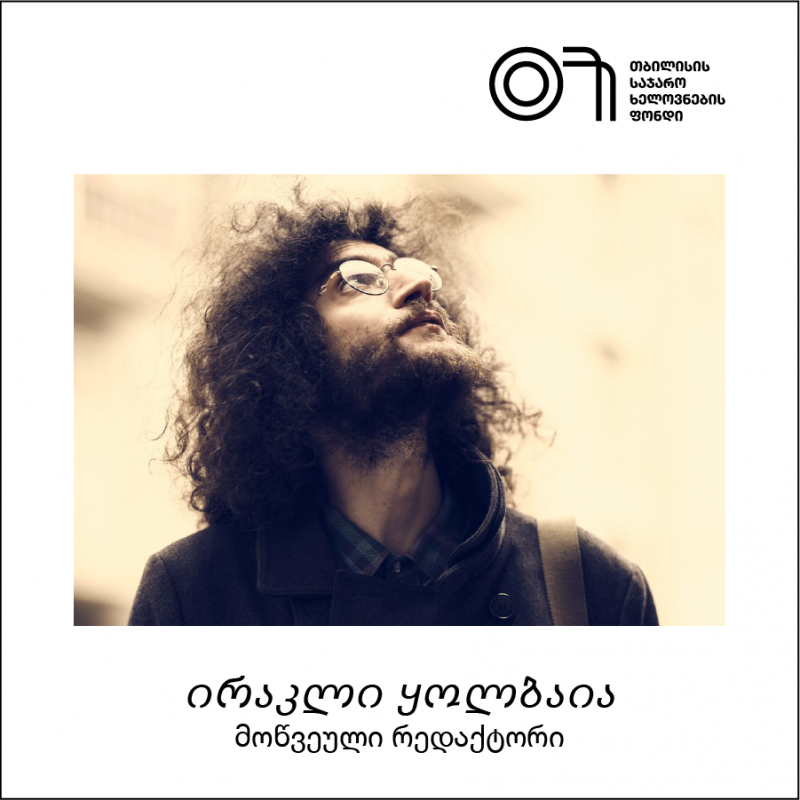
Irakli Qolbaia
= More info =
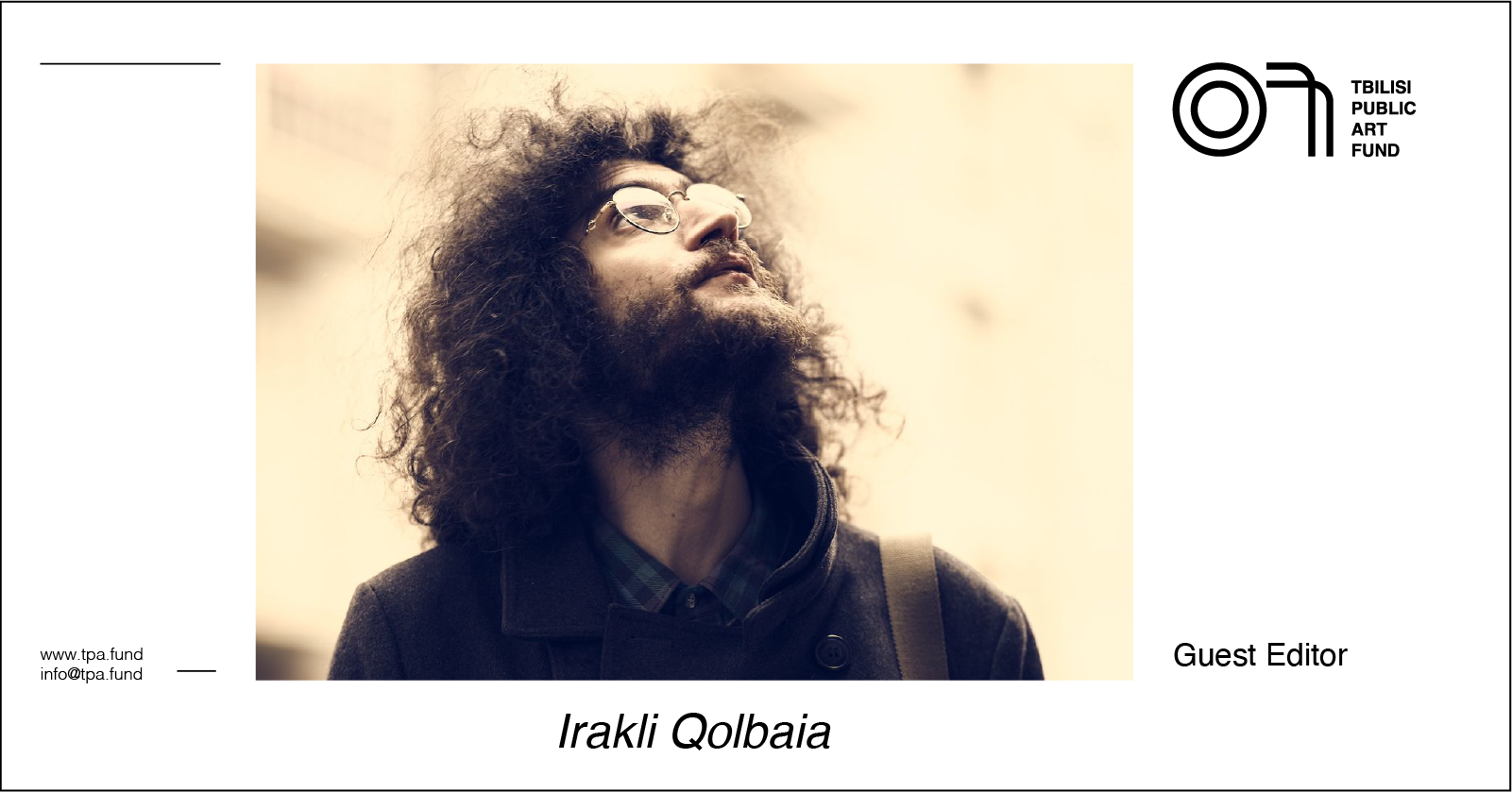
The season's guest editor is poet Irakli Qolbaia.
"Was I to pick a name for the selection of texts I propose here – to explain, say, an underlying design behind my decision – I would go for “Poetry and Art” or “The Verbal Quest for the Image” or “Poetic Inquiry as the Archaeology of Morning” – but what led me to such a design?
To accept this generous offer and serve as a guest editor, for me, meant that I could square a triangle of sorts with two of my recent preoccupations: my translation of Ralph Waldo Emerson’s “Nature” and a tiny collection of translations I named “I Am Going to Make a Poem About War.” In my thinking of them, all these works – by Emerson, Rene Daumal, Max Jacob, Ezra Pound, William Blake – are specific instances of what may be called (in line with Henri Corbin’s Sufi quest) a visionary scholarship. Often, such instances were caused by poets, but not exclusively. One also comes across them in depth psychology, biology, ethnobotany, anthropology or neuroscience (James Hillman, Rupert Sheldrake, Dale Pendell, Iain McGilchrist…) - one more possibility in this direction can be furthered by our current selection: just as, for centuries, the poetic attention has been accorded to nature, so has it attended to Art, the Image, image-making. Poet Charles Olson, who preferred to think of himself as an archaeologist of the morning, said: “art is the only twin life has-its only valid metaphysic.”
In what, for me, happens to be the dearest work by a philosopher about poetry (“The Poetics of Space”), Gaston Bachelard calls the poets and painters the born phenomenologists. “The things speak to us.”
I find it meaningful and worth noting that in my choice of texts I was inspired by translations I would occasionally do for the guest editors before me (John Keats’ “Sleep and Poetry,” a short story by Leonora Carrington, excerpts from Junichiro Tanizaki’s “In Praise of Shadows”); I noticed how often the visual artists, in relation to their creative practice and their field of attention, would choose such works that many a reader, myself included, would deem poetic or, at least, belonging to the literary arts.
So I initially wondered if I should propose an upside down version of that picture: to show how often poets invoke the visual arts to find the necessary, commensurate body to their vision. Works such as Guillaume Apollinaire’s “Caligrammes” (initially to be called “I Too Am a Painter”), Henri Michaux’s work in its entirety – unmatched in our time, Victor Segalen’s “Stelae” and the poetics of the New York School – Frank O’Hara’s “Why I Am Not a Painter” and John Ashbery’s long poems about Parmigianino’s Self-Portrait or the Realms of Henry Darger.
But in the end I went another way – that of visionary scholarship. As the first instance of the poetic study of the image I chose several works by the American poet Clayton Eshleman, all of them taken from his major work, “Juniper Fuse: Upper Paleolithic Imagination and the Construction of the Underworld” – the best place to begin, really, for the book itself seeks the origin of image-making as a human activity. To do so, for over three decades, Eshleman physically entered the painted caves in France, emerging with this book. The book is a fusion of research, free prose, poems, diaries, collage of information and some fifty pages of scholarly commentary and bibliography. So I thought it best to offer bits of these different genres in my selection.
Some of the seminal works for my sense of poetics and the image, as well as the archaeology of consciousness and knowledge, proved to be the books by the English scholar, Frances Yates, her study of the Renaissance and Elizabethan magic – especially meaningful in this context, as I discovered Yates’ books during my brief studies in the History of Art – due to the fact that the French translation of her important work “The Art of Memory” belonged to a master French historian, a great scholar of Renaissance art, Daniel Arasse – and, thanks to these discoveries, Renaissance painting too became a passion of mine. I found that it was filled with secrets that required the eye of a detective, and, at times – when the meaning escapes the academically sanctioned limits of thought – poetic expression. My second choice is an example of this, a short essay by Daniel Arasse from his book “Take a Closer Look” – in this sequence of essays, written in a demotic speech, full of endless jocular inventiveness, Arasse offers a shocking disclosure after another in the most famous paintings of Velasquez, Bruegel or Tizian. In the “The Snail's Gaze” – an essay on the representation of the Annunciation – his discernments attain the metaphysical heights.
With my third choice I wanted to turn back to the point in the past from where, I believe, springs the current we are discussing here – Heinrich von Kleist’s “On the Marionette Theatre” is the most astonishing, unusual and mysterious piece of prose that I have read. It definitely captures that essential focus of the Romanticism that most significantly advanced our understanding of the innate phenomenology of poetry and painting. It is also an essay that still seems to belong to the future. If Arasse manages to invoke the spirit of the sublime Italian painting, Kleist attains a deep Romantic charge in what could be considered a popular, entertaining and lighthearted form of art – and takes us from there to the end of the world, the complete revelation."
Clayton Eshleman, from Juniper Fuse(Here)
Daniel Arasse, The Snail's Gaze (Here)
Heinrich von Kleist, On the Theatre of Marionettes (Here)
Irakli Qolbaia was born and lives in Tbilisi. For over a decade, he has been attending, - through poetry, prose, translation - to a singular aspect of poetics: poetry as a continuous line that runs from the current consciousness to the ancient past - not so much a domain of art as such but a form of spirituality, a practice and a method of visionary scholarship. The years of apprenticeship (which, happily, seem to have no end), alongside writing, was dedicated to translation of Arthur Rimbaud, William Blake, and New American Poetry. Published books include several volumes of prose, poetry and translation in Georgian, as well as "Vegetarian Vampires" (2020, Metambesen); "Night with the Other Hand" (2022, The Swan, Kelly Writers House). A new book, "Birds of Thereat" is forthcoming.