

 View larger
Ilia Chkheidze
= More info =
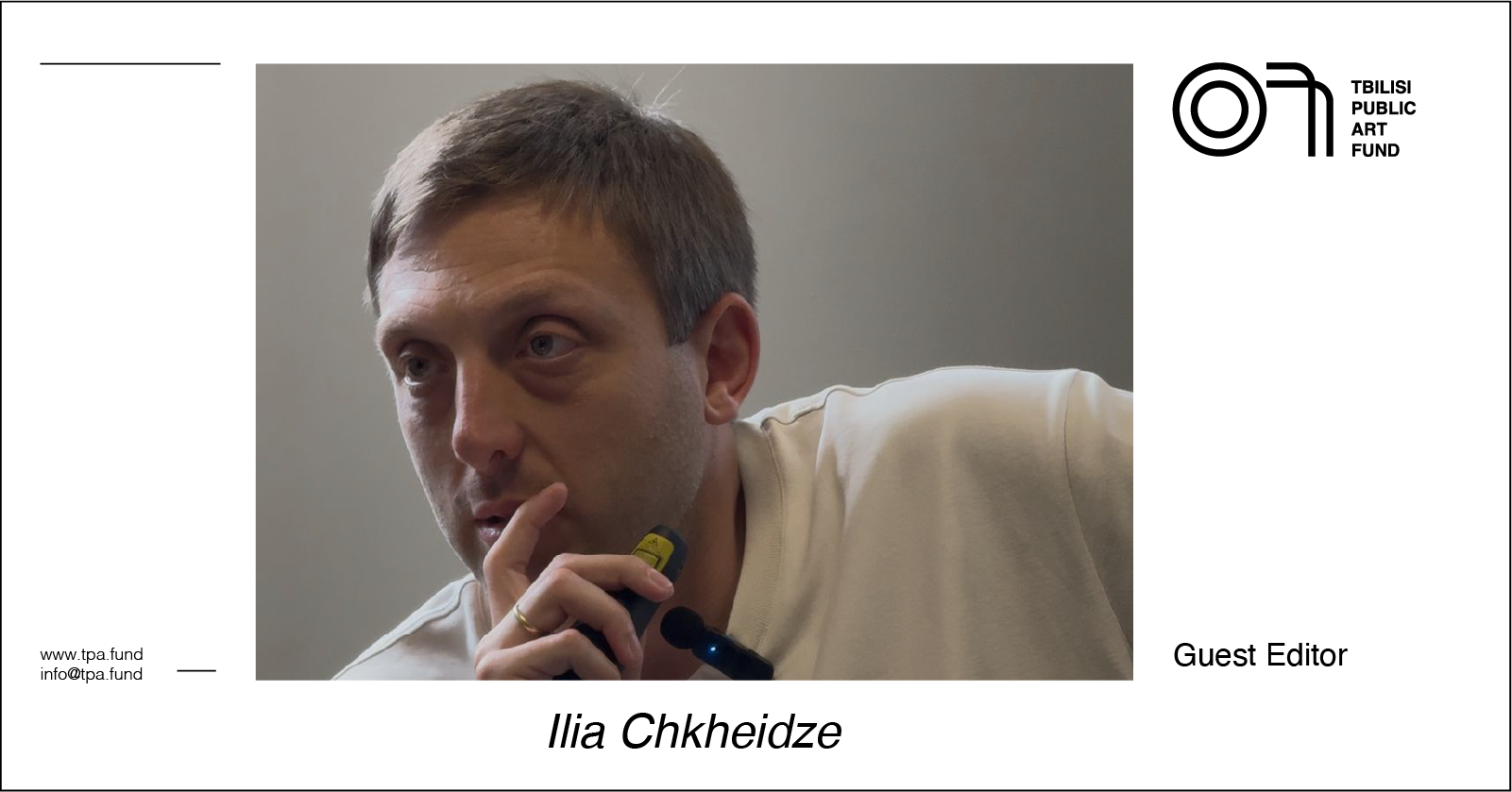
The guest editor for the spring season is Ilia Chkheidze, a specialist in public policy management. His selected texts explore the role of state funding in the cultural field.
„Since the 20th century, the consolidation of neoliberal policies has significantly influenced the production, distribution, and accessibility of cultural activities. Neoliberal economic ideology—marked by market liberalization, deregulation, privatization, and a reduced fiscal role of the state—has reshaped the institutional landscape of culture and the arts. Today, cultural institutions are increasingly governed by market logic, where value is equated with profitability, audience reach, and commercial viability. This shift has led to a decline in public arts funding in many countries, compelling cultural organizations to seek private sponsorships, corporate partnerships, or adopt business-like operating models. As a result, cultural workers face growing instability, while non-commercial forms of artistic expression are increasingly marginalized.
The first article, titled " Economics and the cultural sector: can they achieve a more diplomatic relationship?" by Dave O’Brien, addresses neoclassical economic ideology’s perception of the cultural sector. According to O’Brien, the neoliberal view treats culture as a market commodity, assessed in purely monetary terms—thereby diminishing its social value. In contrast, he argues that the cultural field produces vital non-market values such as trust, identity, respect, and mutual understanding. Culture, he writes, is not merely an economic sector but also a space for identity, critical discourse, and civic engagement. State-funded cultural initiatives can serve as platforms for marginalized voices and help challenge dominant narratives, fostering intercultural understanding.
The second article, "The Loss of the NEA Isn’t Just About Money. It’s About Civil Society" by Philip Kennicott, explores how the decline of cultural institutions weakens the very fabric of civil society. Focusing on cuts to the U.S. National Endowment for the Arts (NEA), Kennicott argues that such reductions affect not only arts funding but also the shared spaces and values that uphold democratic life.
The third piece is a recorded interview with renowned economist Ha-Joon Chang, published by the LSE (London School of Economics) blog. Chang emphasizes that, in a democracy, citizens must be economically literate. Economics is not a neutral or purely technical field, he asserts; rather, it shapes all aspects of social and cultural life. To preserve democratic values and the public good, society must be engaged in economic discourse."
Dave O’Brien. 2012. “Economics and the cultural sector: can they achieve a more diplomatic relationship?” openDemocracy, June 26,2024.
https://www.opendemocracy.net/en/opendemocracyuk/economics-and-cultural-sector-can-they-achieve-more-diplomatic-relationship/?utm_source=chatgpt.com
Stevenson, A. 2025, May 16. The loss of the NEA isn’t just about money. It’s about civil society. The Washington Post, July 22, 2025 https://www.washingtonpost.com/entertainment/2025/05/16/nea-funding-cuts-arts-loss/
Stewart, A. (2014, July 9). Five minutes with Ha‑Joon Chang: “Members of the general public have a duty to educate themselves in economics.” USAPP – American Politics and Policy at LSE. July 22, 2025. https://blogs.lse.ac.uk/usappblog/2014/07/09/five-minutes-with-ha-joon-chang-members-of-the-general-public-have-a-duty-to-educate-themselves-in-economics/
Ilia Chkheidze holds a Master’s in Public Policy from Central European University (Vienna) and lectures at the Georgian Institute of Public Affairs (GIPA). His academic work focuses on the impact of free trade and migration on public policy and economic development. He is actively involved in research and public discourse on socio-economic issues in Georgia and beyond.