
 View larger
Nikoloz Japaridze: Memory and Heritage — Discussion of the stained glass window of the lower pavilion of the funicular
= More info =
The legacy of the Soviet era in Georgia is difficult to perceive as a valuable, positive, or enduring legacy. There are various reasons for this, and analyzing these reasons is a very interesting and relevant task.
During the thirty years of independent statehood, there has been no consensus in society about the legacy of the Soviet period, as even the mere mention of this period often provokes a negative reaction. So how should we identify the “assets” in our country?
Several publications and scientific works are devoted to this topic, namely: “Architectural Map of Tbilisi” (Ana Chorgolashvili), “Construction of Socialist Georgia” (Nini Palavandishvili, Irina Kurtishvili), “Socialist Modernism in the Caucasus” (Dumitru Rusu), “Georgian Soviet Architecture in 50 Years” (I. Tsitsishvili).
The aforementioned publications clearly reflect the relevance of the legacy of the Soviet period, clearly demonstrating, despite its isolation, the moment of the Soviet Union's participation in the international and, especially, European cultural landscape. Moreover, this heritage arouses keen interest not only among ordinary viewers, but also among international researchers.
If the remnants of the nineteenth century - the literature, fine arts, or architecture of Georgia before the Soviet era - are perceived as a positive heritage, both material and immaterial artifacts of the socialist era are not only neglected, but, in many cases, altered beyond recognition or deliberately destroyed.
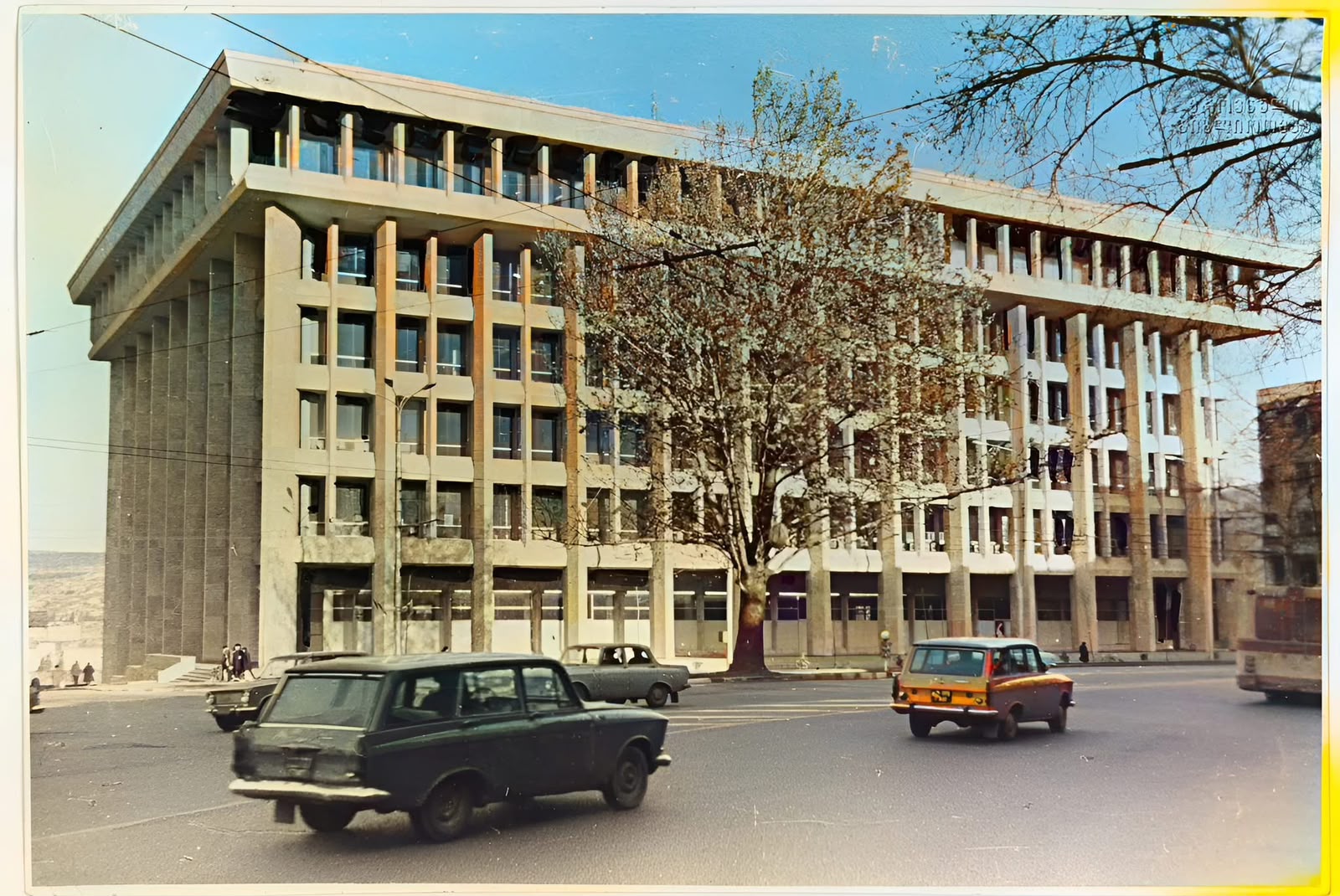
Tbilisi Central Post and Telegraph Building, 1980s
Technological progress has played a major role in both the transformation and disappearance of a number of professional fields, which, in turn, has had a certain impact on the life of buildings and structures. This process, at the same time, has created new opportunities for the transformation or adaptation of abandoned buildings and structures. The possibility of rethinking or transforming such buildings and structures has raised many questions: should this or that building be demolished or preserved? If preserved, then in what form, with what function, etc. A number of buildings require more in-depth research and analysis. The general condition of a particular building, its scale and other specific nuances that may become a prerequisite for disruption are taken into account. The Iveria, Stamba and Telegraph hotels are striking examples of the transformation of Soviet heritage. The analysis of the quality of their reconstruction is a separate topic, but it is welcome that these buildings have retained their “functional” name, which is part of the perception of the Soviet era.
In addition to the buildings, many decorative samples have survived, which require special attention, because their value is even more difficult to determine. In many cases, these architectural samples are partially or completely destroyed, and their restoration is almost impossible. However, their maintenance would require less money and effort.
***
Such is the case with the lower pavilion of the funicular and its decorative elements. In the 1900s, the idea of developing the so-called “Upper Tbilisi” on the Mtatsminda plateau emerged, and the first project, developed on the initiative of the Belgian engineer Alphonse Roby*, was approved. This project was, in fact, implemented entirely by European specialists.
The history of the Lower Pavilion can be roughly divided into four periods: the original pavilion in the Euro-Asian eclectic style, built in 1905; the Soviet modernist pavilion with stained-glass mosaics from 1971; the blue "flower," or temporary plastic pavilion, from 2011; and the current – the original, albeit modified – pavilion, built in 2012.
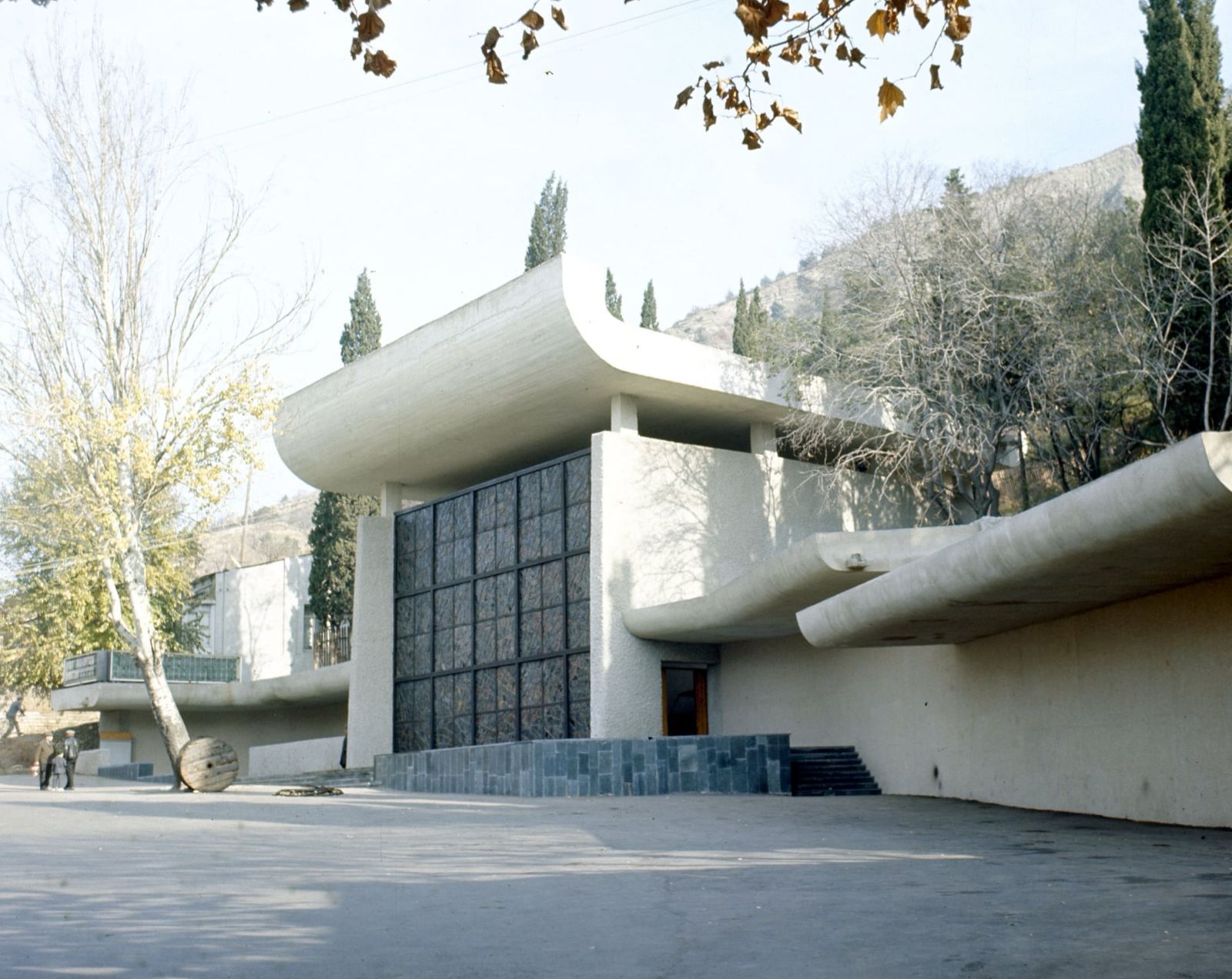
Funicular cable car lower station, 1980s
The original 1905 Eurasian Eclectic Pavilion (which contained a stained-glass mosaics*) was replaced in 1971 by a Soviet modernist building. In 2006, the pavilion was demolished, resulting in the loss of stained-glass mosaics created by Vakhtang Kokiashvili, the founder of Georgian stained-glass art. These mosaics, called "Beriakoba," adorned the pavilion's lower platform, and its placement was considered particularly striking against the contrasting darkness of the interior.
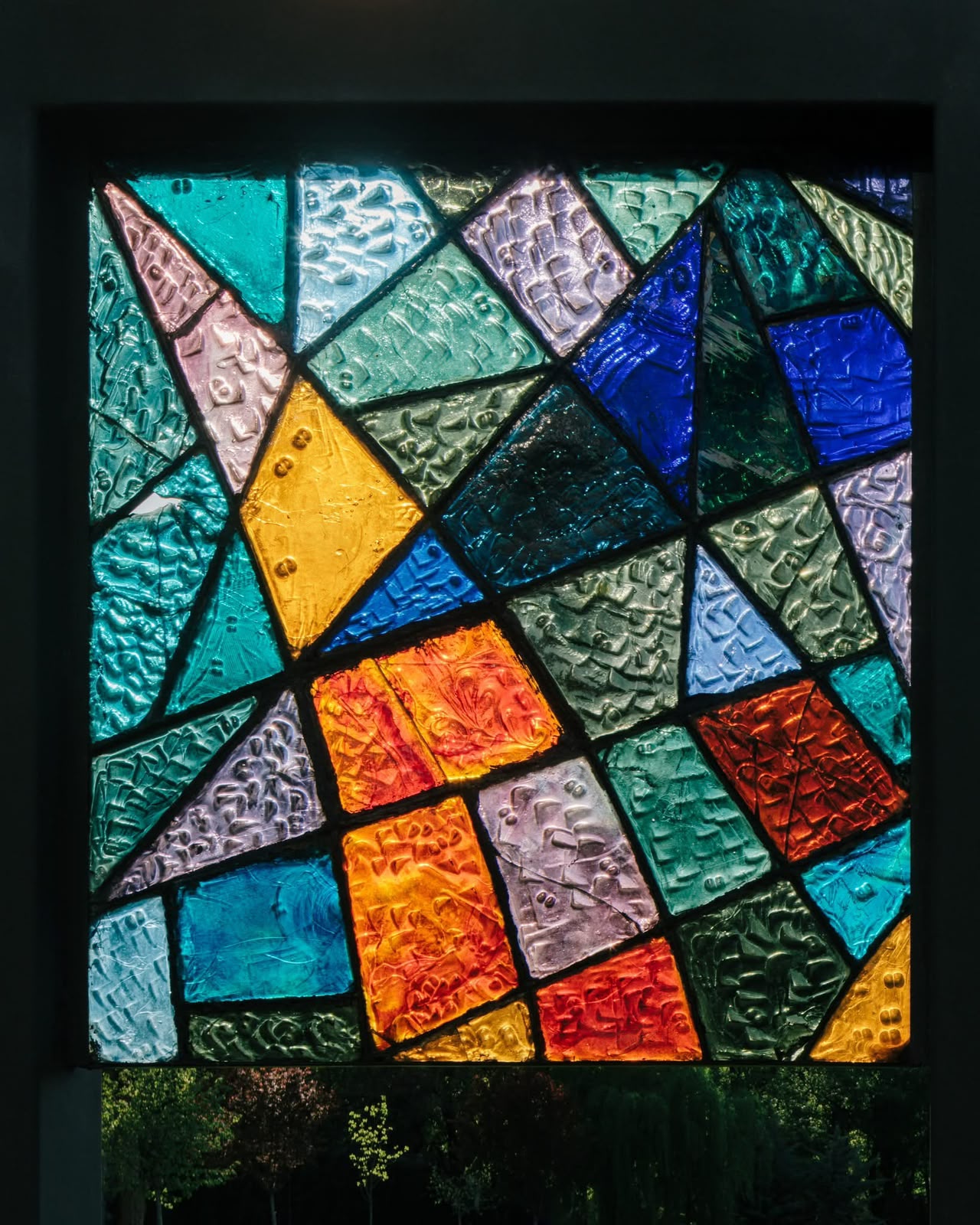
The pavilion's rectangular stained glass window consisted of 60 square-shaped panels filled with a composition of geometric shapes of variously colored glass. The plot of "Berikaoba", an abstract masked dance, was brought to life by the play of sunlight. The glass elements were made at the Riga (Latvia) glass factory, where the color of the glass was obtained by adding iron salts. The artist had mastered this complex technology brilliantly.
It is noteworthy that the earliest stained glass windows are found in the 1870s in the Church of Saints Peter and Paul, in the houses of Bethlehem Street at the end of the 19th century, and by 1903–1905, in the form of formal Art Nouveau examples, in the Writer’s House. In other words, the technology of stained glass windows was introduced to Tbilisi in the late 19th century, most likely through the construction of European churches, and soon spread to domestic contexts.
Berikaoba — Georgian folk improvisational mask theater. The term "berikaoba" refers to a spectacle celebrating the cult of fertility and childbearing and is derived from the common Georgian root "ber" (son).
Seeing these stained glass mosaics remains in my memory as a kind of celebration of art, especially in the morning hours, when, as I descended from the funicular, the sunlight penetrating the stained glass completely filled the interior of the pavilion with different colors. It was a festival of light and color. It is also noteworthy that abstract art, banned during the Stalin era, as well as the Khrushchev-era decree of simplification and cheapening in the 1950s - “no decoration”, still made its way into art. In this regard, Vakhtang Kokiashvili’s contribution to the development of abstract art is undoubtedly great. His works were exhibited in 2019 by the Window Project, which demonstrated his broad artistic vision and artistic genius. Unfortunately, Kokiashvili’s large-scale decorative works have almost been destroyed. (Hotel "Iveria", the lower pavilion of the funicular, Hotel "Ritsa" in Sukhumi, etc.)
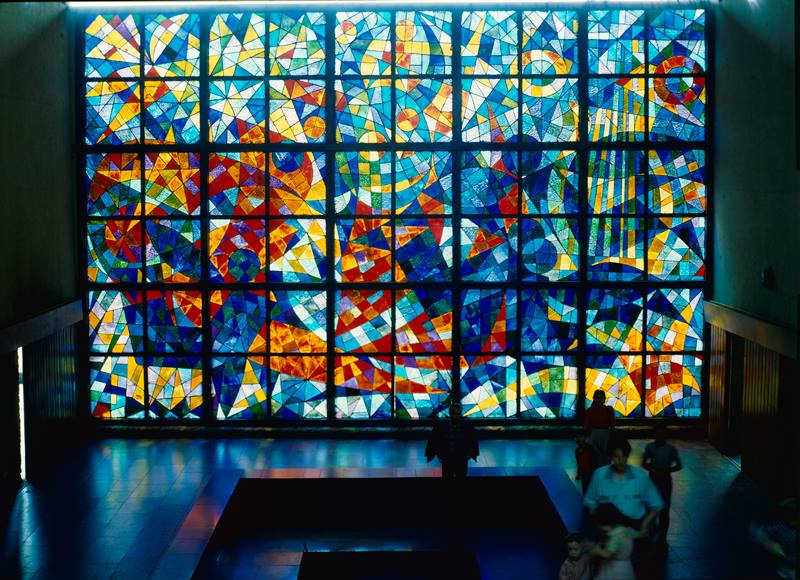
Funicular cable car lower station, 1980s
The stained glass was lost after the pavilion was dismantled in 2006. Only fifteen years later were parts of the stained glass mosaics found in the warehouse of the private owner of the funicular. Unfortunately, most of the stained mosaics are lost, and the majority of the surviving fragments are not amenable to restoration.
Through the efforts of the Tbilisi Public Art Fund and conservator Nino Kokiashvili, the stained-glass work was partially restored. Since the surviving elements were being kept by a private owner, transferring them back into the public domain presented a new challenge. The Tbilisi Public Art Fund found a legal solution for the return of the fragments, making the restoration of the stained glass possible.
In the 30 surviving frames of the work, missing or shattered glass elements were replaced using the scattered fragments that had been recovered. In this way, the preserved frames were once again completely filled with coloured glass. Each panel was reconstructed according to the artist’s original drawing, following a process resembling the assembly of a “jigsaw mosaic.”
For understandable reasons, returning the stained-glass panels to their original location was impossible. However, it was important to both the Tbilisi Public Art Fund and the artist’s family that the work should once again be displayed in a public space. The Fund therefore announced an open competition for a proposal to install fragments of Vakhtang Kokiashvili’s stained-glass work, Berikaoba, in Mziuri Park. The winning proposal, developed by the teams of TIMM Architecture and Studio 501, envisioned placing the panels within a specially designed, robust steel frame structure. The resulting installation was ultimately installed in the lower section of Mziuri Park.
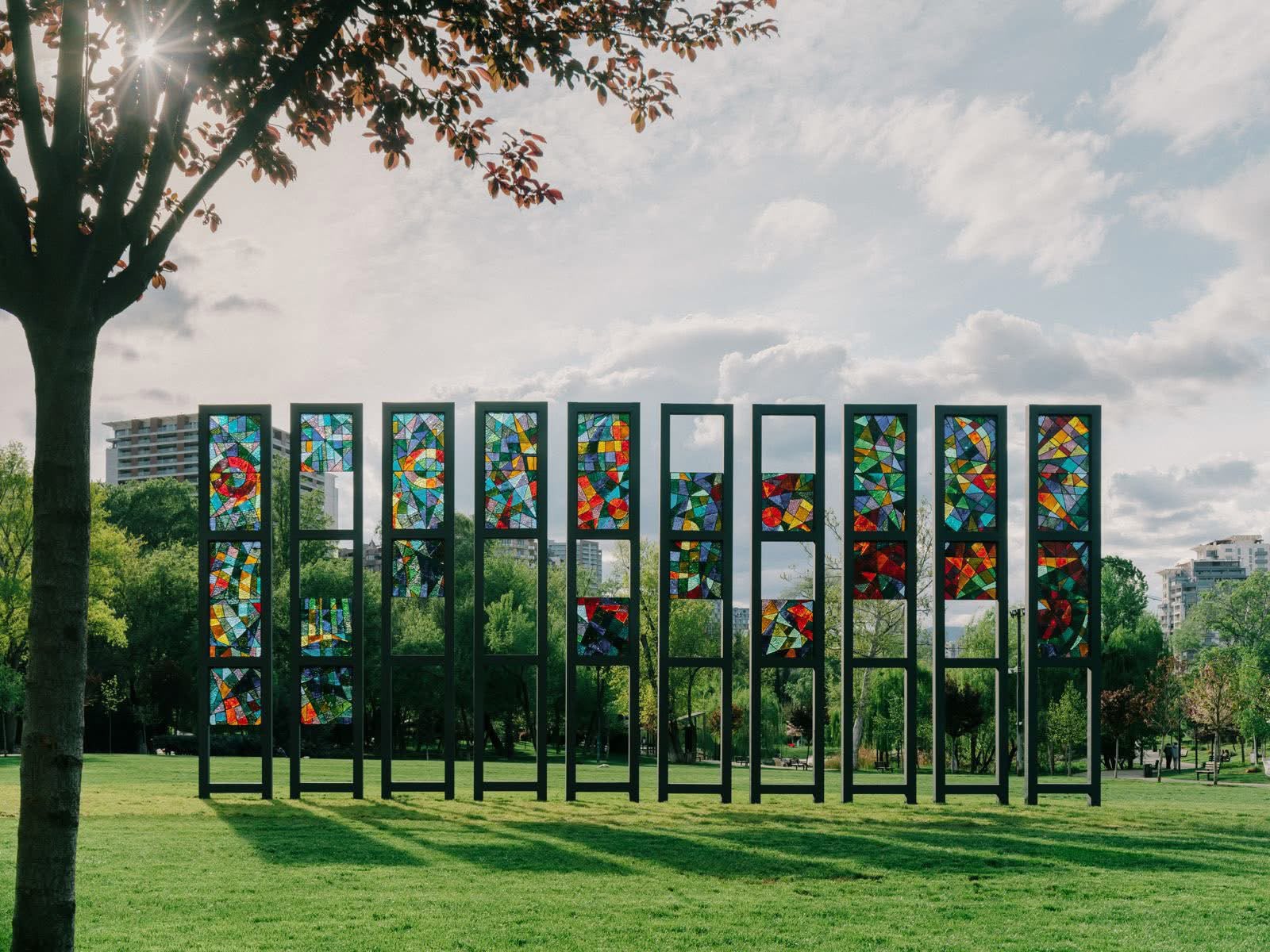
Fragments of Memory, 2025, TIMM Architects, Studio 501, Mziuri Park
It is noteworthy that the stained glass tiles are arranged according to the composition of the original panel, and the missing parts are left as empty spaces. According to the authors, “the fragmentary nature of the work, on the one hand, leaves a feeling of incompleteness, and on the other hand, it allows for interpretation through emptiness.” The new composition uniquely decorates the park in the form of a sculpture, but raises the question - why is the composition empty in places? This question is already a prerequisite for interpretation.
---------------------------------------------------
The history of the Funicular Pavilion is symptomatic of our existence and reflects our attitude towards history. Unfortunately, every new political force deliberately destroys and obliterates the remnants of previous governments. It seems to be trying to erase memory, to prove that life begins anew on the path to a better future. As if new construction must necessarily take place on the ruins of what remains.
How can we change this erroneous approach or tendency in order to preserve the past and perceive it as the foundation for building the new? How can we understand where the yesterday of our history was - in the nineteenth century, during the Soviet period, or, more recently, in the recent past? Why do we only pay attention to our historical wealth and value when it is discovered by a foreign gaze unburdened by our own conditioning? In response, this possible solution appears to us:
The inclusion of Soviet heritage in the list of monuments is a necessary and national matter. Currently, only the statuses of “monument” and “historical zone” are valid in Georgia, which does not allow for the protection and preservation of important elements, not to mention the protection of buildings as a whole. On the other hand, a particular building may have a very interesting and valuable element, but the building itself may not be of great value. What should we do in this case?
***
In comparison, the English List of Historic Buildings, Architectural, Cultural Heritage, is divided into several categories - Grade I is for buildings of special interest; Grade II* (with an asterisk) for buildings of particular importance that are not of special interest; and Grade II - for buildings of special interest, which is the most common category.
Also, in England, a heritage site is a historic building, place or monument that is part of the national heritage collection and is managed by the English Heritage charity. This charity looks after more than four hundred publicly owned buildings in England, ranging from prehistoric monuments and Roman castles to abbeys and historic private houses. The organization's aim is to maintain and conserve these buildings for posterity.
In addition, local planning authorities manage a wide range of places, from historic town centres and villages to 20th-century suburbs, industrial sites and country estates. There are around 10,000 conservation areas in England.
***
It is important to analyze and describe such diverse assets in order to promote their maintenance and tourist attraction. For example, if a developer or owner wants to restore or remodel a building to gain some benefit, he or she should be encouraged to do so. However, this process will become difficult considering the protection of the structure and the prohibition of interference in it. That is why there is a gradation of the list of monuments protection.
Seeing the situation through a neutral lens can help protect and conserve historical heritage. The project to restore the stained glass mosaics of the Funicular Pavilion is a clear example of a vision for the future, when history is not perceived as a useless artifact, but as a solid foundation of our heritage.