

 View larger
Shota Iatashvili: The Transformations of Tbilisi Reflected in Poetic Works
= More info =
Every city has its moments of transformation—periods when something fundamental changes. It is often poets who are the first to sense and capture these metamorphoses. This essay is an attempt to show how Tbilisi’s transformed—or perhaps deformed—identity has been reflected in the work of Georgian poets across different periods.
To do so, it is necessary to begin with several key poets from earlier generations before turning our attention to the era that unfolded before our eyes, or is, indeed, still unfolding. For Tbilisi, the most recent turning point came during the tragic early years of Georgia’s independence. Beyond the fact that the city itself was crumbling throughout the 1990s, struggling helplessly to rise from its own ashes, equally significant was the transformation of the buildings that survived the catastrophe. They acquired new appearances and new functions, while new people moved into them to begin different kinds of lives and work. More broadly, the city’s inhabitants learned to live differently—with altered rules, new ways of perceiving the world, an unsettling sense of instability, and a quiet, concealed optimism.
This dramatic reality, intertwined with nostalgia and other fundamental human emotions, is vividly present in the poetry of the period and continues to resonate through the work of subsequent generations. The poetic images of Tbilisi brought together in this essay, and the analysis that accompanies them, reveal the city’s inner and outer dynamics—the forces that propel it forward, reshape it, and carry it into new states of being, while either preserving, or, regrettably, failing to preserve, those qualities that are most organic and indispensable to its identity.
Shota Iatashvili, Transformations of Tbilisi reflected in Poetic Works (Here)
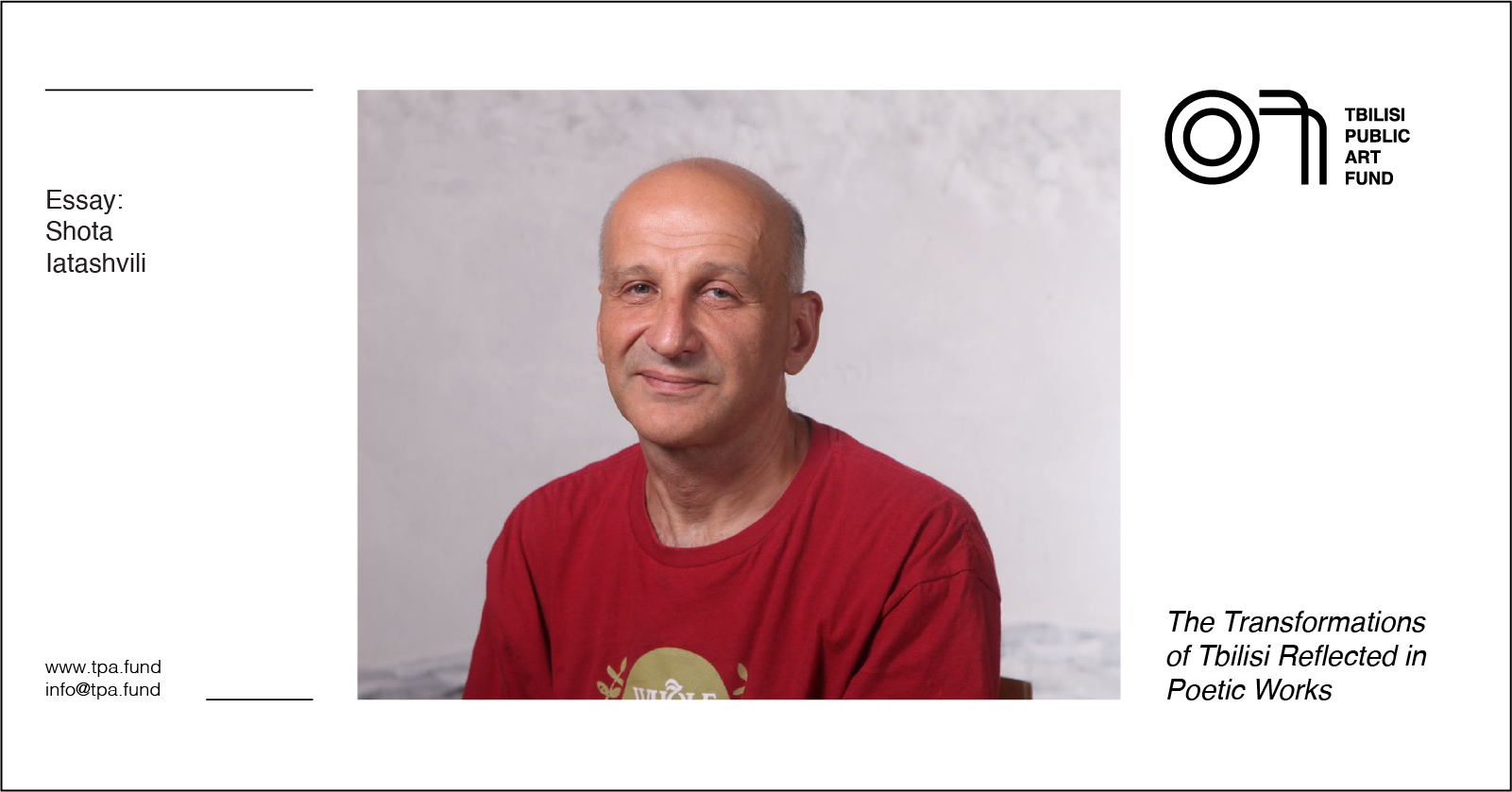
Shota Iatashvili (born in 1966) is a Georgian poet, prose writer, translator, and literary critic. He is the author of ten poetry collections, four collections of prose, two novels, a fairy tale, a collection of critical essays, and several translated books. He is a two-time recipient of the SABA Literary Award (Poetry, 2007; Literary Criticism, 2011), as well as the Litera Award for Poetry (2020) and the Free Litera Award for his novel (2022). Iatashvili has also received numerous international literary honours, including the Kyiv Laurels (Kyivski Lavry) Prize(Ukraine, 2009), the Klemens Janicki Prize for his book Golden Section (Poland, 2018), the Vilenica Crystal Award(Slovenia, 2018), and the Best Poem Award at the Plovdiv–Orpheus Festival (Bulgaria, 2022). His works have been translated into more than 25 languages, and his books have been published in Ukraine, Poland, and Azerbaijan. He currently serves as a consultant and editor of the Tbilisi International Festival of Literature.