

 View larger
Qeu Meparishvili: Healer
= More info =
The Tbilisi Public Art Fund is pleased to present "Qeu Meparishvili - The Healer" one of the winning proposals selected through the "Project Call 2026." Starting October 3, 2026, the artwork will be installed on the platform of the Vazha-Pshavela metro station.
The practice of young multimedia artist Qeu Meparishvili vividly demonstrates the diversity of her creative curiosity and interests. Her experimental approach integrates various media and materials - ranging from neon and ceramics to diverse sculptural and spatial forms. Recently, the artist has also been actively exploring the technique of metal chasing, using it to create works of varying shapes and scales.
Chasing (metal embossing) is one of the oldest and most significant branches of decorative and applied art. In Georgia, the art of chasing boasts a centuries-old tradition, with medieval ecclesiastical goldsmithing being particularly renowned. However, in the 20th century, it experienced a revival in a new, monumental form and became an integral part of Soviet architecture.
From the 1960s, as modernist architecture rapidly developed in Tbilisi, the art of metal chasing assumed a prominent place in public spaces. During this period, artists and sculptors integrated metal reliefs into the interiors and facades of new buildings, thereby creating a synthesis of traditional Georgian artistic language and modern architecture.
The placement of Qeu Meparishvili’s chased metalwork within the Tbilisi Metro complex is particularly interesting. Opened in 1966, the Tbilisi Metro stands as a prominent example of the architectural and artistic trends of the 1960s; this lends additional historical and visual context to a contemporary artist’s use of a technique closely associated with that same era.
From the very beginning, metro stations were conceived not merely as transport infrastructure but as cultural and artistic spaces, where architecture, sculpture, mosaic, and artistic metalwork merged to create a cohesive visual environment. The metal panels and reliefs adorning the station interiors often drew upon motifs from Georgian history, folklore, and ethnography, thereby becoming a form of cultural identity expression within a modern architectural setting.
Qeu Meparishvili’s work also seems to engage in a dialogue with this artistic legacy - returning to a medium historically characteristic of the metro, yet infusing it with a contemporary artistic language and new content. In doing so, the work not only continues the tradition of the metro as a space where art and architecture synthesize, but also revitalizes the idea that the metro is more than just a place of transit - it is a space of everyday life where art has the opportunity for direct and constant interaction with people.
It is also fascinating to observe how Qeu Meparishvili interprets the centuries-old tradition of metal embossing, integrates it with the Soviet context, and subsequently transforms it entirely into her own contemporary artistic language. Her works do not aim to merely reproduce historical forms; rather, they place the material and symbolic memory of traditional techniques within a completely new visual context. In her hands, metal - a historical medium - becomes a vehicle for expressing contemporary urban experience and visual culture.
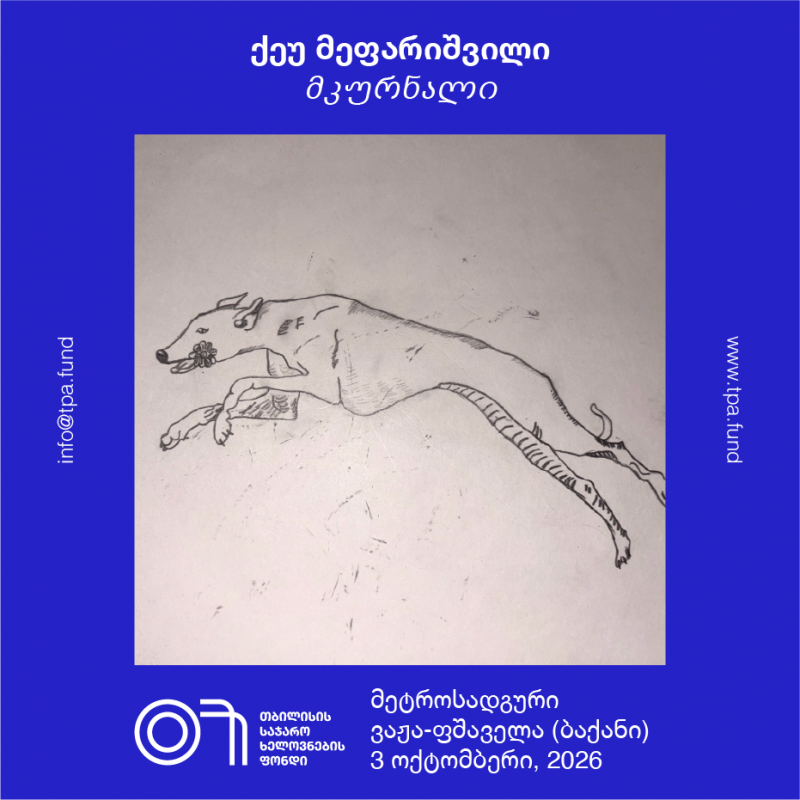
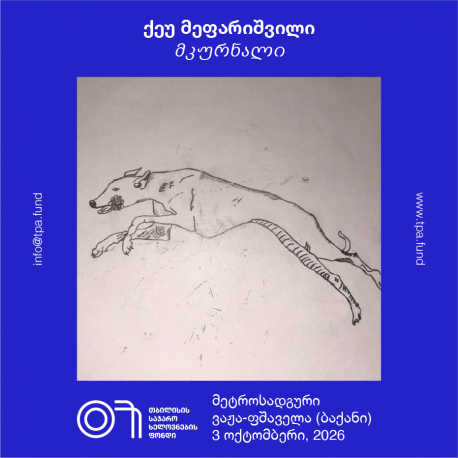
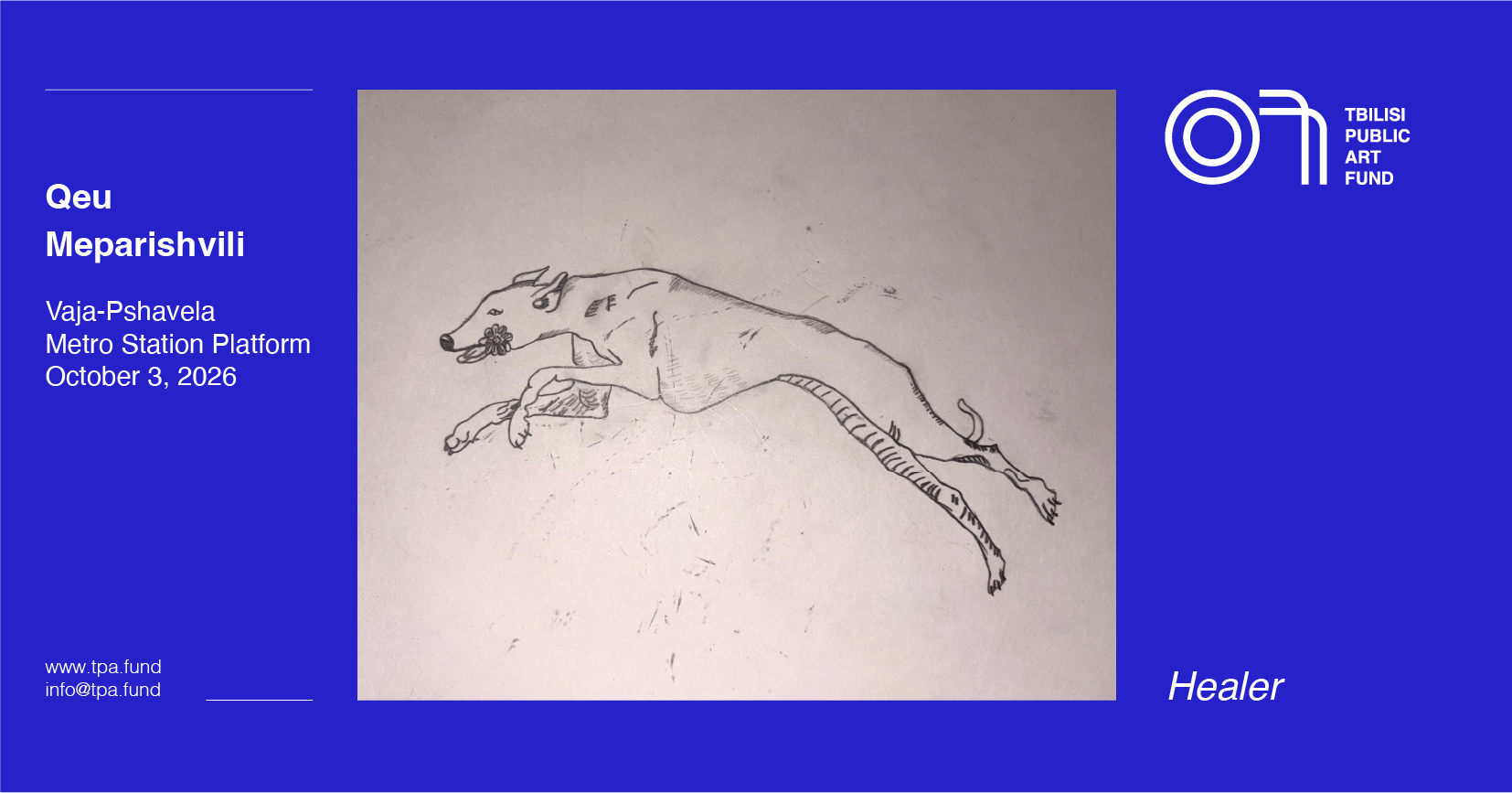
In the embossed panorama displayed on the platform of the Vazha-Pshavela metro station - amidst zoomorphic forms and elements inspired by the urban environment - a figure of a dog in motion creates a central visual line. This can be perceived either as a group of dogs running together or as the movement of a single dog unfolded into a sequence of film frames - akin to chronophotography; it is as if the artist is making another foray into the history of art and visual culture, echoing Eadweard Muybridge’s famous photographic experiments. By capturing motion in successive phases, Muybridge made it possible to see what the human eye cannot perceive as distinct moments due to the speed and complexity of the movement. Thus, the recurring figure of the dog in the panorama not only creates an illusion of motion but also transforms time into a visual form, drawing attention to that which often lies beyond immediate human perception. Thus, a seemingly ordinary, unremarkable scene from urban life shifts into a new dimension - taking on a cinematic quality and opening up a wide spectrum of metaphorical and symbolic interpretations. In this context, the figure of the dog itself is particularly noteworthy. Given the artist's characteristic symbolism and keen sensitivity to mythological imagery, the dog appears repeatedly in her work, in various forms and contexts, thereby imbuing this specific image with additional symbolic significance.
For the artist, the dog - and the stray dog in particular - embodies whole range of dichotomies: between the wild and the domesticated, freedom and control, order and anarchy, aggression and solidarity, vulnerability and strength, and exclusion and autonomy. The simultaneous coexistence of these opposing states lends the figure of the stray dog a distinctive poetic ambiguity, transforming it into a multi-layered, ever-shifting symbol within the artist’s creative discourse. In this sense, it can also be perceived as a metaphor for collective memory - a symbol of the experiences and marginal narratives that persist in the city’s daily life yet often remain unnoticed, forgotten, or unacknowledged. Thus, the figure of the dog is not merely a part of the urban environment but also a bearer of the invisible histories and experiences that lie beyond the city’s official narrative.
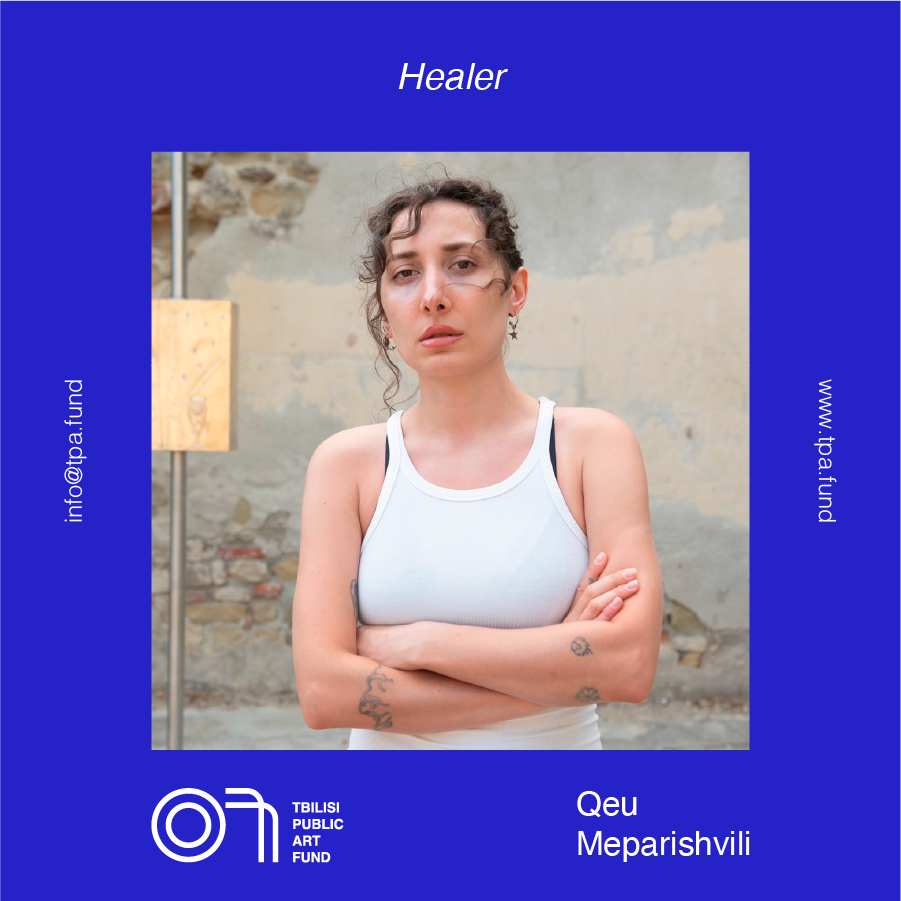
Qeu Meparishvili is a multimedia artist who lives and works in Tbilisi. She studied at the Shota Rustaveli State University of Theatre and Film, and later at the Center for Contemporary Art (CCA). An important part of her creative practice is the dialogue between traditional and modern life, a kind of preservation or continuity. She explores mythology, human nature and collective memory, combining personal experiences and public themes.
Her works have been presented at international exhibitions in Georgia, Belgium, France, Austria and Italy, including: Shrine of the Stray (Citerna, 2025), Grey is the Cube, Blue the Ellipse (Amiens, 2025), Chimeras Memorial (Tbilisi, 2024), Delving into Bones Liquor (Antwerp, 2023), If Words Became Violent (Vienna, 2019) and others.