

 View larger
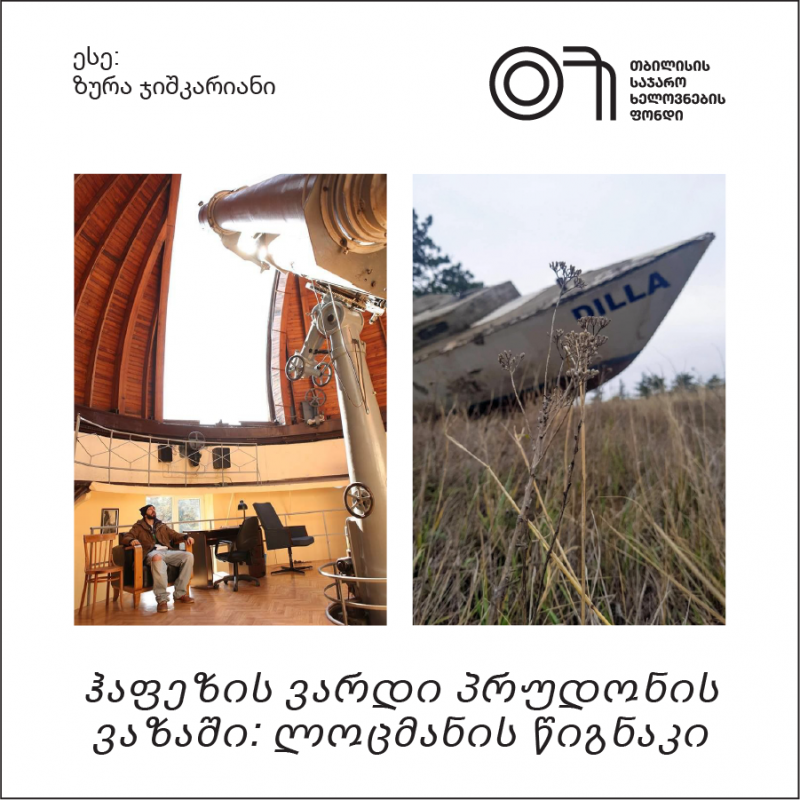
Zura Jishkariani, Hafez's Rose in Prouhdon's Vase: A Harbor Pilot's Notebook
= More info =
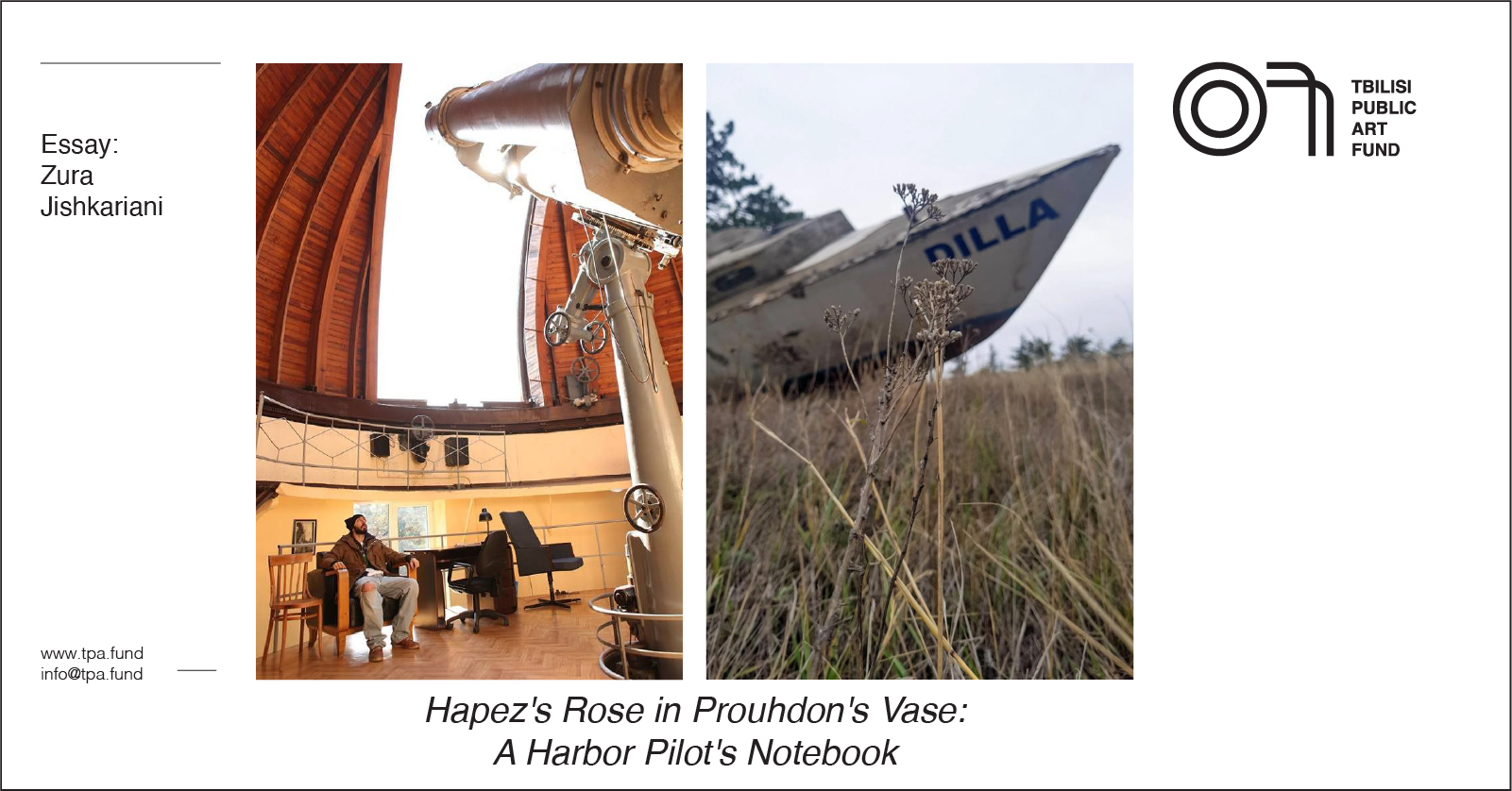
In the essay "Hafez's Rose in Proudhon's Vase: The Pilot's Notebook," Zura Jishkariani reflects on his many years of psychogeographical practice. This practice involves bringing the sea into a landlocked city, constructing ports between Soviet-era Khrushchyovka apartment blocks, and other phantasmagorical interventions.
On the map of Tbilisi's secret rooms are marked all the addresses where citizens have gone into "internal exile." Yet, while the purpose of internal exile is usually understood as escape, Jishkariani seeks to "go inward" in order to return to the city with a renewed way of seeing.
Aimless, accidental, or carefully planned wandering becomes, for the writer, a mode of transport—a means of entering the city's political and existential unconscious. Active imagination serves as an instrument of urban magic, one of the most powerful tools without which it is difficult, and at times impossible, to challenge or transform existing reality. Exile is understood as a "negative gift" from God, while transformation is described as "acquiring new eyes." By changing one's perspective, it becomes possible to overturn established hierarchies.
After twenty-three years of living in Tbilisi and moving from one neighborhood to another, Zura traces connections between his various projects—exhibitions, texts, and experiences of inhabiting the city. Yet the seemingly logical links and the narrative they create ultimately point toward the illogical, the non-narrative, and, in the language of the market, the non-productive. At first glance, this appears to be a dead end; yet by rethinking it, the possibility of a miracle emerges.
The writer emphasizes that this is the nature of Tbilisi's palimpsest: layered, contradictory, and fantastical. Indeed, during the years of the First Republic, Tiflis itself was known as the "Fantastic City."
The hidden and invisible processes of visible Tbilisi—its buildings, apartments, and the "Fantastic City" concealed within the city itself—form a barricade of resistance whose line cuts through everyday life into countless fragments. Within these fragments lie hundreds of other cities: the city's doubles, each with a different destiny and an ephemeral existence. Within this ephemerality slumbers the potential city. The writer strives to bear witness to the city as a living organism.
For it has been said:
"We are not yet free; the heavens are still capable of collapsing upon us."
— Zura Jishkariani, Hafez's Rose in Proudhon's Vase: The Pilot's Notebook
Zura Jishkariani, Hafez’s Rose in Proudhon’s Vase: The Booklet of Lotsman, (click here).
Zura Jishkariani, a writer and self-proclaimed mayor of Sukhumi, was born in 1985 in Sukhumi. He pursued his studies from 2003 to 2006 at Tbilisi State University, focusing on the Faculty of Social Sciences. In 2024 he returned to the academia to complete his degree. His academic interests revolved around language and its boundaries, viewing language as both a tool for communication and a reflection of past human experiences.
Jishkariani first gained public attention through his involvement in the musical project ‘Kung Fu Junkie’. His musical endeavours viewed music as a form of language and he’s been involved with other popular Georgian musical projects. Notably, his exploration of non-verbal communication was showcased at ExpoGeorgia in 2017 with the exhibition 'Who Will Still the Roaring of The Seas?' and at the SOU festival, featuring a suspended ship connected to the Black Sea via sensors, producing sounds corresponding to the sea's waves.
As a writer, Jishkariani stands out in contemporary Georgian literature with his unique narrative and writing style. His debut novel, 'The Chewing Dawns: Sugar Free' received critical acclaim, earning the 'Best Novel of the Year' award from Ilia State University in 2017 and the 'Saba' literary prize for the best debut in 2018.
In addition to his literary pursuits, Jishkariani is actively involved in high-tech projects, including video games and chatbots. Notable examples include 'CyberGalaction', a chatbot based on the poet Galaction Tabidze, and 'Oraculum 0.1', an interactive installation featured at the Frankfurt Book Fair in 2018. His video games, such as 'My Georgia', 2023 and 'GRANELY', 2024, blend text and technology to engage students and gamers alike.