

 View larger
Poetry in Motion: Erekle Deisadze, Traveler's Angel
= More info =
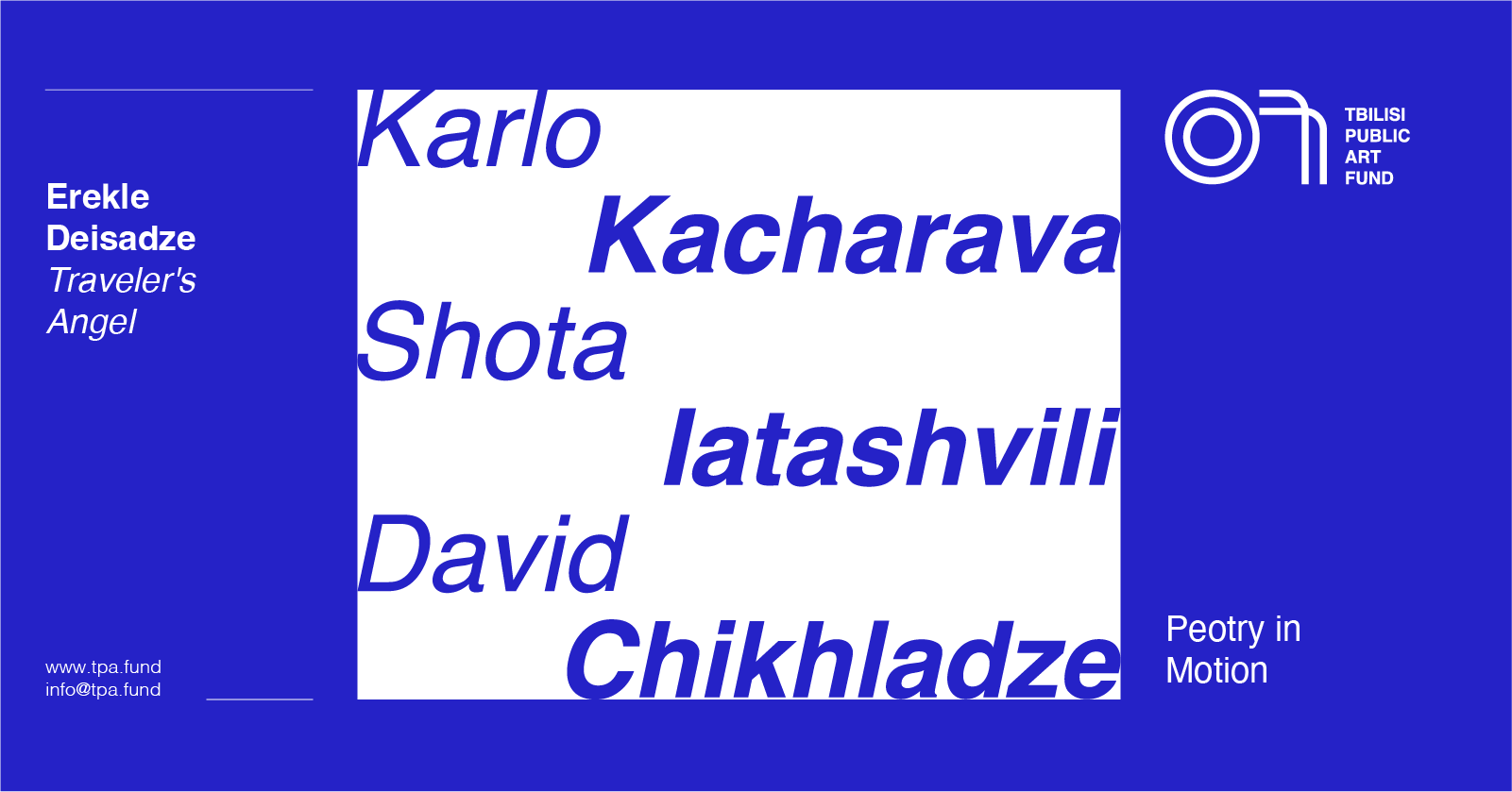
The Tbilisi Public Art Fund is pleased to present a new initiative, Poetry in Motion, and its first collaboration, Traveler’s Angel, with poet and musician Erekle Deisadze.
Within the framework of the project, the artist shares his research on Georgian poetry of the 1990s–2000s, focusing on three authors: Karlo Kacharava, David Chikhladze, and Shota Iatashvili. Excerpts selected by Erekle Deisadze from these poets’ works will be displayed inside Tbilisi Metro carriages, transforming the metro’s everyday functional space into a literary field where poetry temporarily leaves the pages of books and merges directly with the rhythm of the city and the experience of its passengers.
Poetic texts appearing in metro carriages replacing commercial advertising acquire new meanings within the contemporary urban environment. In this way, the project creates a dialogue between past and present, between personal and collective memory, and presents poetry as something living, moving, and accessible to all.
Erekle Deisadze: “The poets presented here, beyond being children of the same era, defined the poetic landscape of that period through their individual voices and distinct forms—a landscape that, over time, managed to gain legitimacy within culture. Today, these texts allow us to assess that reality from a distance, the people of that time with their challenges and emotions.”
The Fund began its collaboration with poet and musician Erekle Deisadze within the framework of its educational program, when the artist presented a series of author-led lectures titled Georgian Poetry Revisited to senior students at various public and private schools in Tbilisi. Georgian Poetry Revisited focused on the work of twentieth-century Georgian poets and aimed to develop students’ artistic skills and to open up new ways of reading and engaging with the school curriculum.
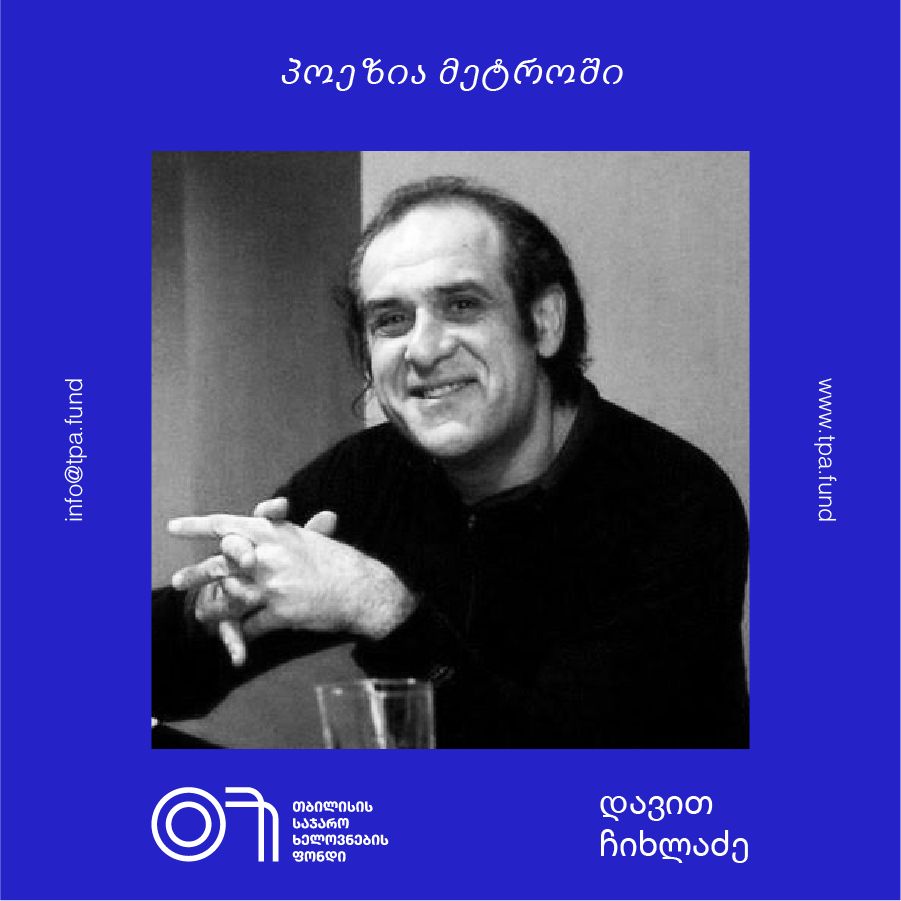
Poet and theater director David Chikhladze was born in 1962 in Tbilisi. His poems and critical essays have been published in Georgian literary periodicals since 1981. He has published several poetry collections: “8 Haiku” (1992), “Wandering Drops” (2001), “December Nights” (2008), “Книга реальности” (The Book of Reality, 2004, in Russian), as well as the novel “Feminine/Feminine” (2007).
His poems have been included in numerous anthologies and collections, including “An American Avant Garde: Second Wave” (Ohio State University, 2002, USA), the journal “Salz” (2004, Austria), “Emergency Gazette” (2000, USA), “Three Green Tea” (2004, USA), “Sanzona Girls” (2015, USA), “Dagbladet” (Norway), “Stroker, Missivves” (France), “Beorama” (Yugoslavia), and “Dekorativnoe Isskustvo; Gumanitarni Fond” (Russia), among others.
In 1989, he founded Tbilisi’s first independent “Alternative Art Gallery,” which was reviewed extensively in the United States the same year (Kim Levin, Connoisseur, 1989). Since 1994, he has led Margo Korablyova’s Performance Theater in Tbilisi. In 2000–2001, he presented theatrical works at the legendary New York theater Collective: Unconscious. From 2002 to 2004, he collaborated with the New York theater Repetti Chocolate Factory during its formative stage.
His video design for the performances “Audit, Drowning Man” and “Fundamental” received positive reviews in the New York theater press. In 2006, he presented his own “lexicon method” of electronic poetry writing at the City University of New York (CUNY). In 2006–2007, he trained with Richard Foreman in the Ontological-Hysteric Theater production “Wake Up Mr. Sleepy! Your Unconscious Mind Is Dead!”.
In June 2025, four selected performances from the 1990s were restaged with 13 reconstructions in Switzerland, in collaboration with American artist Sir Serpas, as part of the Art Basel week, during his exhibition at Kunsthalle Basel.
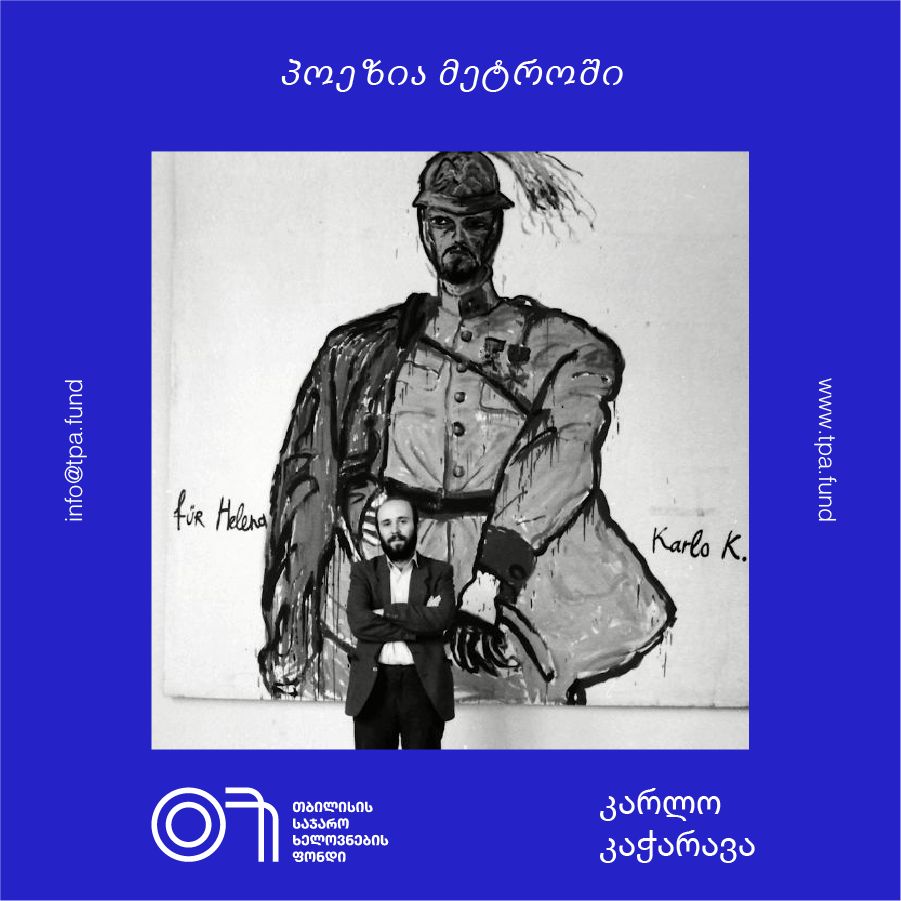
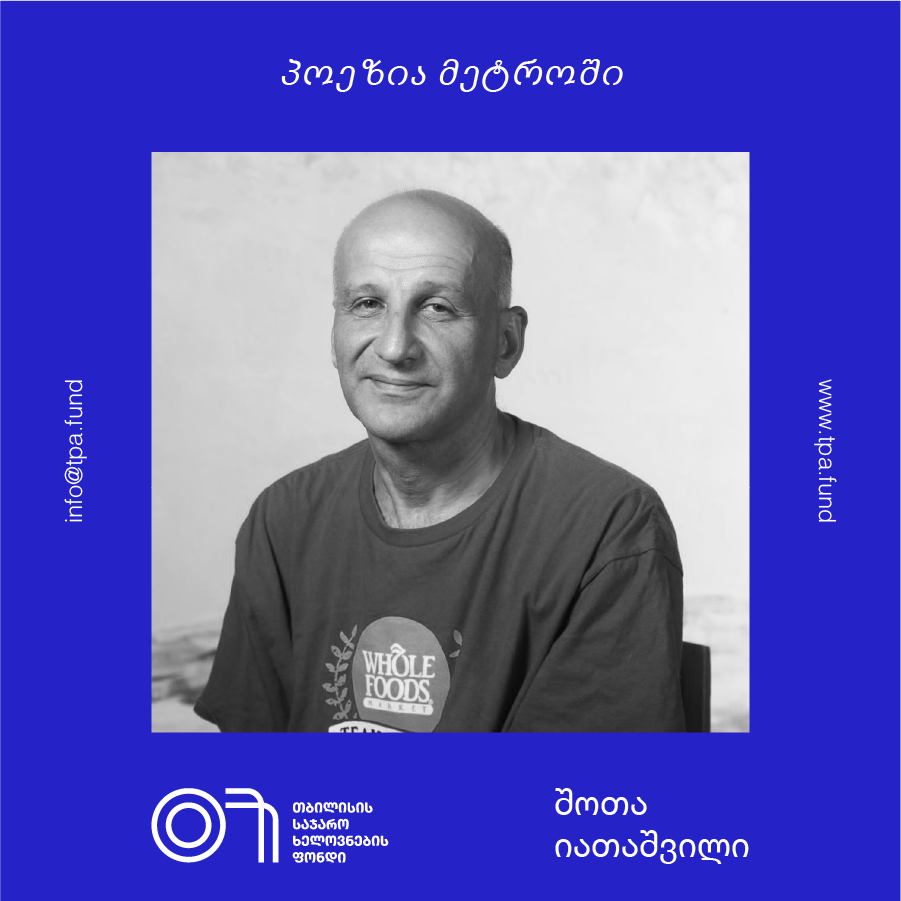
Shota Iatashvili (born in 1966) is a Georgian poet, prose writer, translator, and literary critic. He is the author of ten poetry collections, four collections of prose, two novels, a fairy tale, a collection of critical essays, and several translated books. He is a two-time recipient of the SABA Literary Award (Poetry, 2007; Literary Criticism, 2011), as well as the Litera Award for Poetry (2020) and the Free Litera Award for his novel (2022). Iatashvili has also received numerous international literary honours, including the Kyiv Laurels (Kyivski Lavry) Prize(Ukraine, 2009), the Klemens Janicki Prize for his book Golden Section (Poland, 2018), the Vilenica Crystal Award(Slovenia, 2018), and the Best Poem Award at the Plovdiv–Orpheus Festival (Bulgaria, 2022). His works have been translated into more than 25 languages, and his books have been published in Ukraine, Poland, and Azerbaijan. He currently serves as a consultant and editor of the Tbilisi International Festival of Literature.
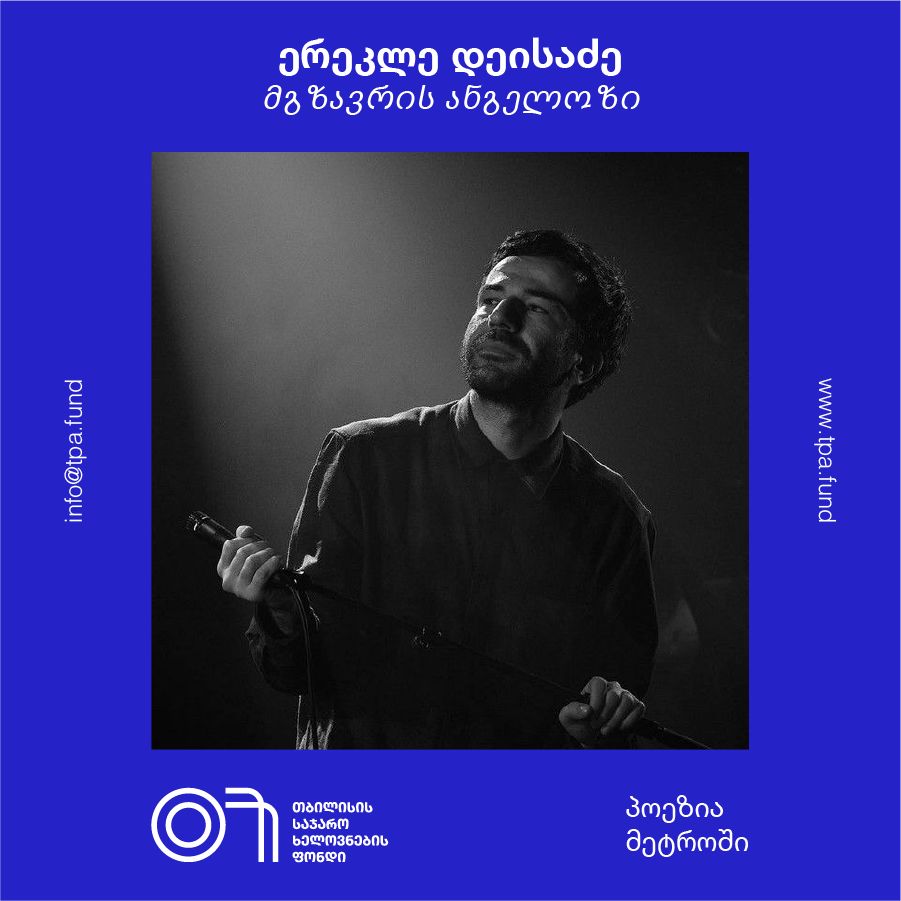
Erekle Deisadze (born 2 April 1990, Kutaisi) is a Georgian poet, writer, and musician. After graduating from Kutaisi Public School No. 1, he continued his studies at the Shota Rustaveli Theatre and Film Georgia State University, where his interests developed at the intersection of literature, performance, and contemporary culture.
Deisadze began his musical career with the band Parallel Generation, where he established himself as a lyricist known for his socially engaged and politically critical writing. He came to national prominence in 2010 with the publication of his debut book, Saidumlo Siroba (Secret Fucking), which provoked widespread public debate. Addressing political and religious themes in an uncompromising manner, the book generated strong and often conflicting reactions, making Deisadze one of the most controversial figures in contemporary Georgian culture.
In 2012, he founded the punk band 40 Kilometrshi (40 Kilometres Away), whose work is characterised by explicit political messages, a protest aesthetic, and an alternative musical language. During the same period, he directed several politically charged music videos responding to contemporary social and political developments. That year also saw the creation of the musical project Eko & Vinda Folio, through which Deisadze continued to experiment with the intersection of literature and music.
Today, Erekle Deisadze remains active as both a writer and musician. His work continues to provoke public discussion and is distinguished by its strong authorial voice, critical perspective, and uncompromising resistance to conformity.