

 View larger
Akaki Burkadze: Art Beyond Borders: A Psychologist of Visual Imagery
= More info =
Art Beyond Borders: A Psychologist of Visual Imagery
How does the object come about in the mind of an artist? What animates the artistic process? How is a mental object materialized and brought to the public? To what extent does the viewer understand the artist’s language? – I started pondering these questions while visiting the San Francisco Museum of Modern Art in the spring. Questions I bring forward equally concern art history and psychology. Assessments, on the other hand, follow from a psychological perspective, linked with the mental processes of object perception, representation, and reading.
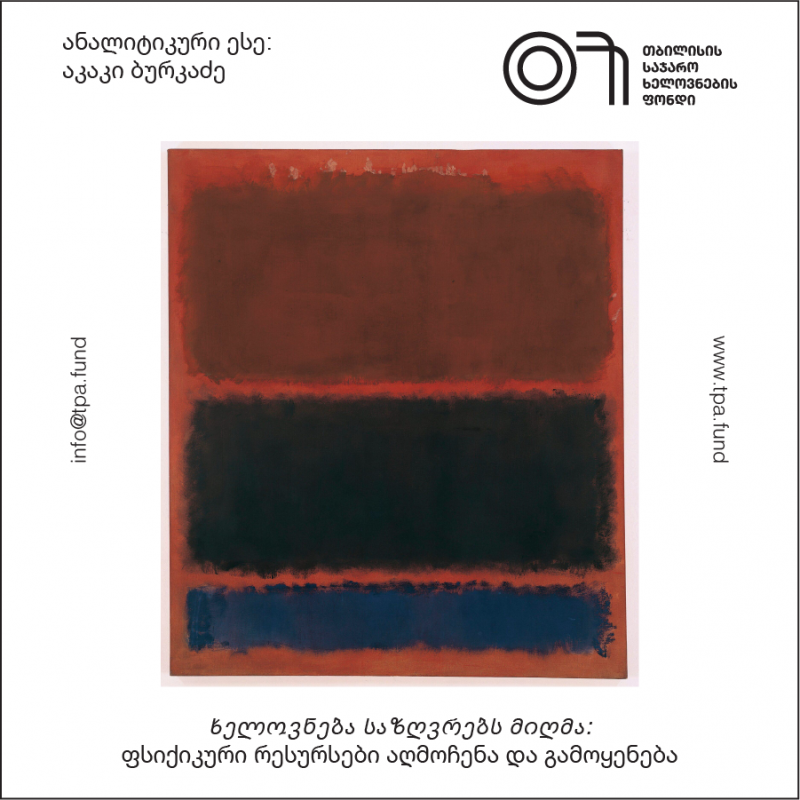
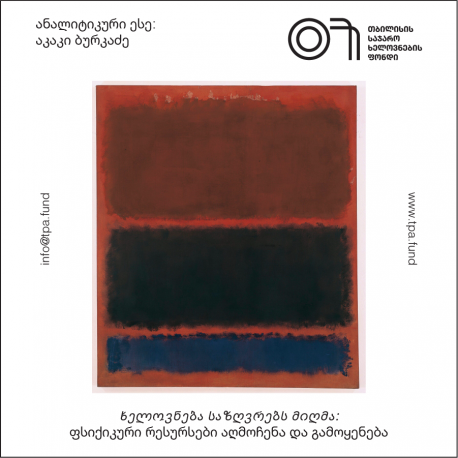
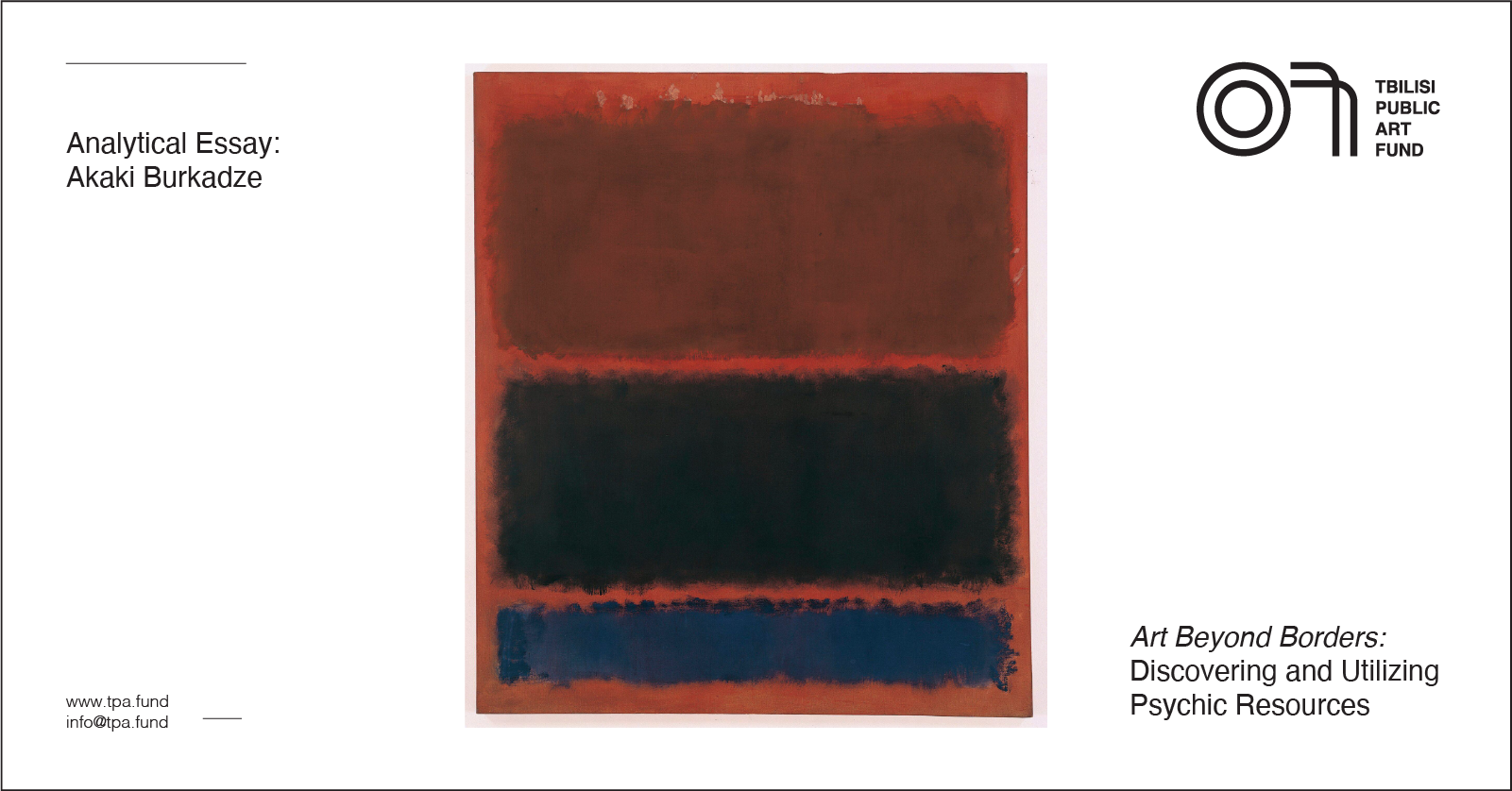
In writing this analytical essay, the main inspirational source became a canvas by Mark Rothko – No. 24 (Brown, Black and Blue), 1958, with sorrow, charge, and melancholy of its browns, blacks, and deep blues. The subject of this canvas is human stories; Fragments of autobiographical memory, ones with no ties to Rothko. It has no other subject. The purpose of the colors is to dive into own subconscious, draw a story, and self-analyze. This picture is a frame, within which the viewer composes their narrative. This gives stimulus to raw conversation. Infatuation with the physiological literature and mythology, immersion in the archetypes of the ancient world, and their revival in contemporary life, bold experiments in selecting imagery and color – all point to Rothko knowing exactly what he was creating. He is one of the 20th-century intelligentsia of painters, who realized that the gods and demons hidden in the human psyche clash in the oeuvres of modern authors. They awaken the viewers’ fantasies. They are not aimed at bringing aesthetic satisfaction and transmission to a static state, but rather evoking sensations and thoughts, encouraging spiritual or physical motion, and last but not least - mental catharsis.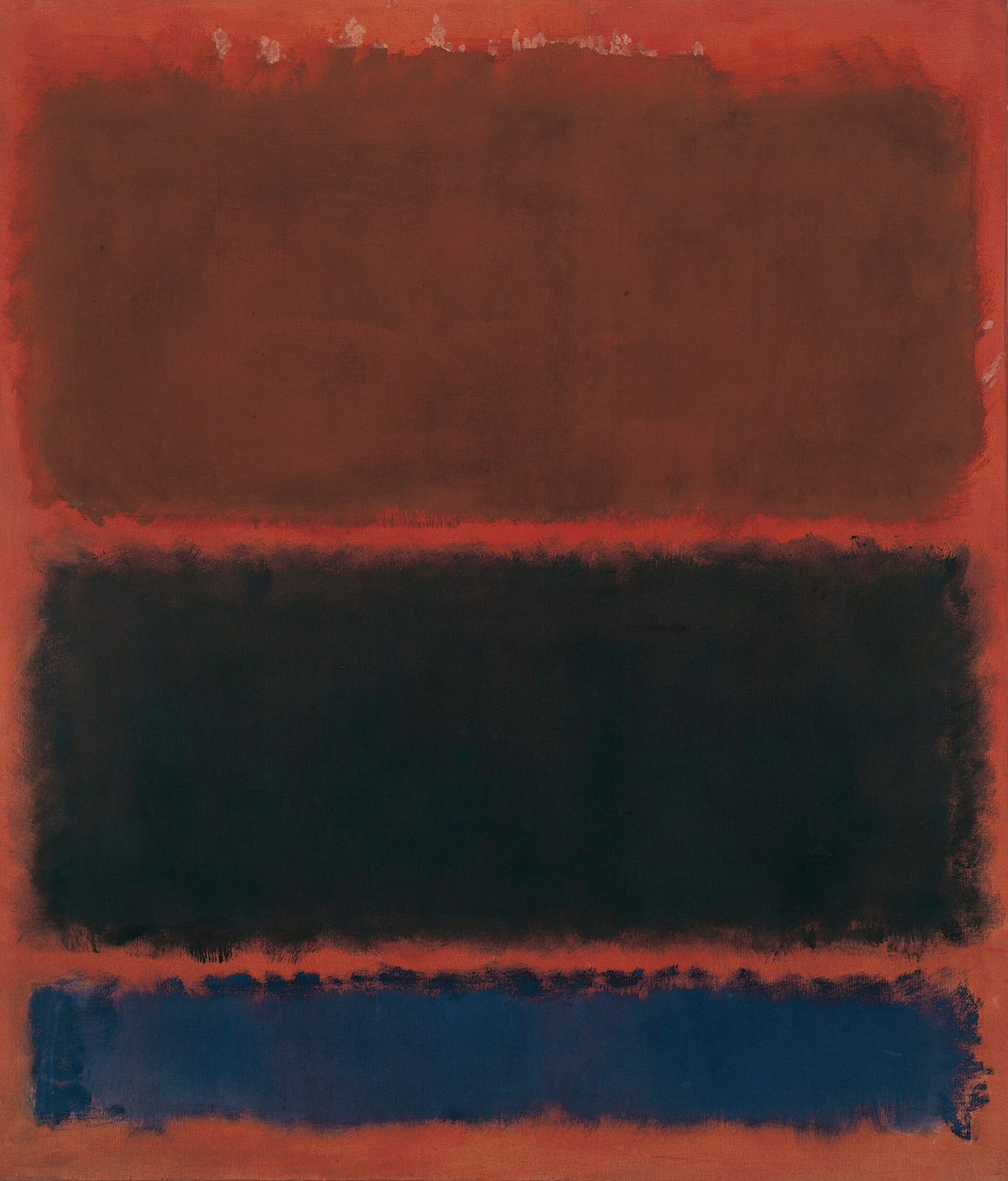
Mark Rothko, No. 24 (Brown, Black and Blue), 1958
Object Perception
A majority of art historians regard the understanding of psychological laws as essential in deconstructing the object. They speculate about the mechanized processes occurring in the artist’s mind. For instance, for Ernst Gombrich, it is submerging in the ‘Mental Illusion’ that begins with sensory perception of an object. In this process, the mind captures, filters, and processes information based on existing knowledge, expectations, and cultural schemas. The artist’s attention is focused on a particular feature of the object. For example, painters might be responding to color, texture, and form. After processing, the sensory information transforms into a mental representation and visual image. Its materialization depends on the cognitive and motoric skills.
While processing the information, the artist might be confronted with various kinds of inspiration, determined by emotional stimulus, that sways the direction of color, composition, and stylistic choice. The interrelation between cognition and emotion feeds the development of sequential artistic vision. At this stage, the object, which the artist intends to represent, becomes total and elicits a vision of the form in which it should materialize. Motoric and cognitive skills determine the actions necessary for this process. Firstly, the object is conceptualized, and later, it takes shape. Depending on the working medium, this might refer to a brush stroke, modelling, a digital edit, or other gesture. Demonstrating creative skills activates the right hemisphere of the brain. It guides the comparison of the represented objects with the mental image. In this process, the object designed by the artist gets revised, refined, and molded to the mental image.
Perception of the object gains a different form when mental illnesses are present. One interesting research in this direction belongs to a German psychiatrist, Karl Jaspers, who studied the work of Vincent van Gogh from the angle of schizophrenia. He observed the works created during the moments of the artist’s state becoming more severe. Based on analyzing these works, Jaspers concluded that the purpose of van Gogh’s oeuvre was to transform reality and portray it in a form that transcended human capabilities. Another conclusion that the psychiatrist made when studying the work of the Dutch painter concerns artistic dynamics. He believed that the mental illness in the case of this particular author became a source of developing a unique style, and that this could be applied to other artists as well.
The correlation between the arts and mental disorders is successfully utilized in the art world by various authors. For instance, the renowned surrealist artist Joan Miró often resorted to starvation to induce hallucinations and discover the unknown parts of the psyche. His goal was to conduct a dialogue with the subconscious and retrieve the unique images it stored. This method found popularity in the entire surrealist movement. Surrealist authors, inspired by Freudian ideas, were attempting to free the mind and create art that had no rational frame or bounds, and pertained to the discovery and reconceptualization of subconscious desires repressed by consciousness.
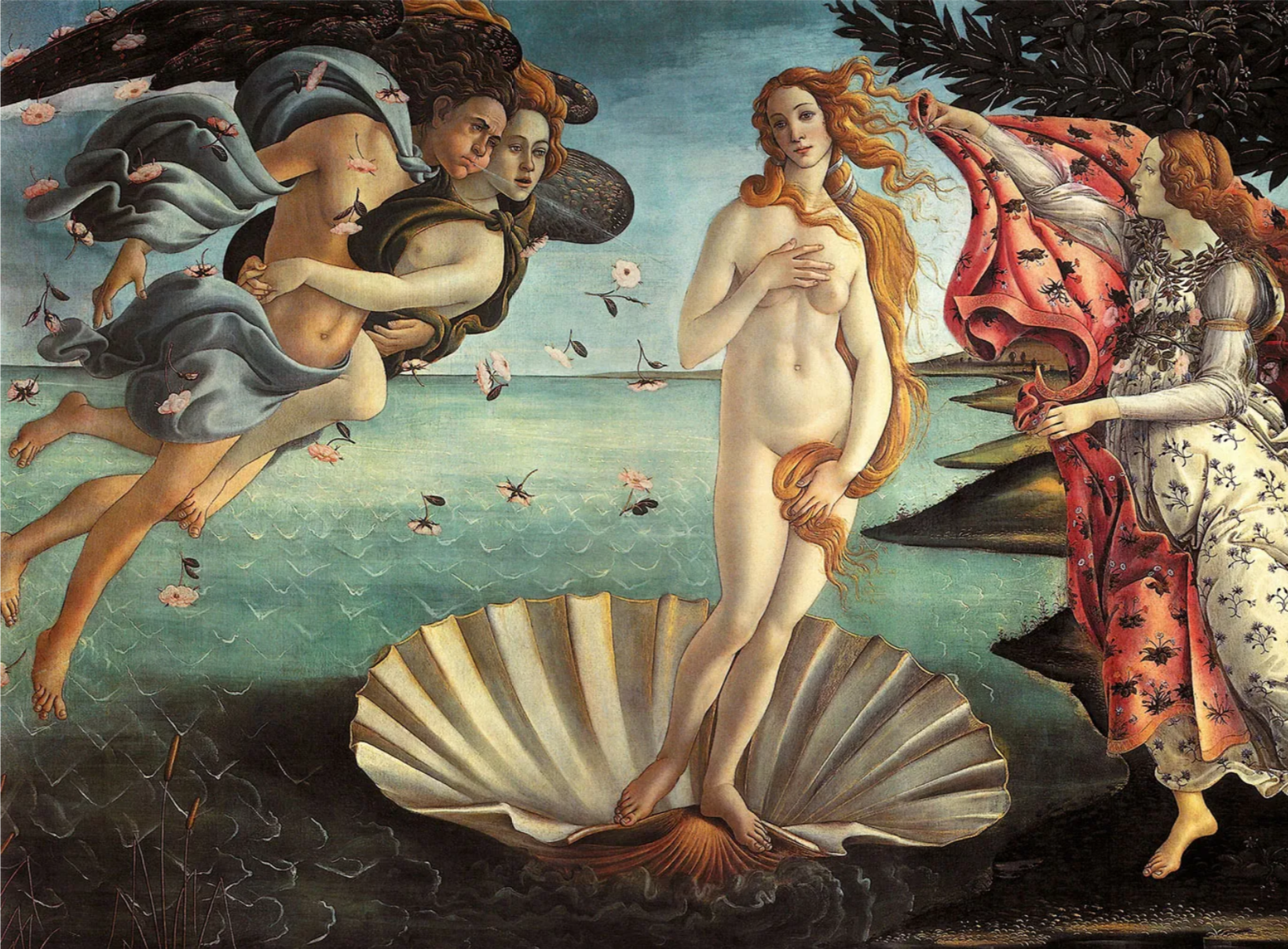 Sandro Botticelli, The Birth of Venus, 1485
Object Representation
‘Mechanical’ dimension of art is what I call the processes of perceiving and filtering information. Such occurs in the mind of any given artist, regardless of which cultural space or educational school they belong to. Art objects are differentiated by social or, if you will, cultural dimensions, which urge the artist to ‘process’ the object. The conceptualization of an object and its rendering in a particular form transpires based on the images and ideas existing in a specific cultural environment. A great attention is paid to this factor in today’s studies. This brought about a unique art language and style, which changed in parallel with the changes in time and space. The growing interest in this dimension is indeed responsible for the fact that in the contemporary world, art is regarded as a means of storytelling, exchanging emotions, communicating with oneself and society, and is no longer merely subject to an aesthetic function. Contemporary artist tells a story. This might be - an autobiographical moment frozen in time, a social event, a mythical figure, etc. The wish of storytelling revives the mental images already perceived and tucked away in the mind, ones that relate to the present scenario, and become a conception. Mental schemas determine what becomes relevant for the author, where they will find their object, and how they will manage to interpret, conceptualize, and represent it. What symbols will they draw from the collective subconscious pool of their society, and how will they link and portray this with their object? These events enliven the artistic process, stirring the mind and motor system.
After completing the work, the artist terminates the established connection, concerning which Lucian Freud wrote - “The promise of it [happiness] is felt in the act of creation, but disappears towards the completion of the work. For it is then the painter realises that it is only a picture he is painting.” In this phrase, art historians recognize the death of the artist and separation from the represented object. For me, as a psychiatrist, this phrase of Freud depicts the emotional processing and objectification of sensory information. An overwhelming inspiration and yearning for the closest possible representation of the mental image can become a source of deep frustration. Similar to Pygmalion, the author is no longer left with an animate figure, a moving or articulate canvas. All of their mastery is left behind in the picture, concluding and anticipating the viewer, who will read their own story in it, composing their own narrative.
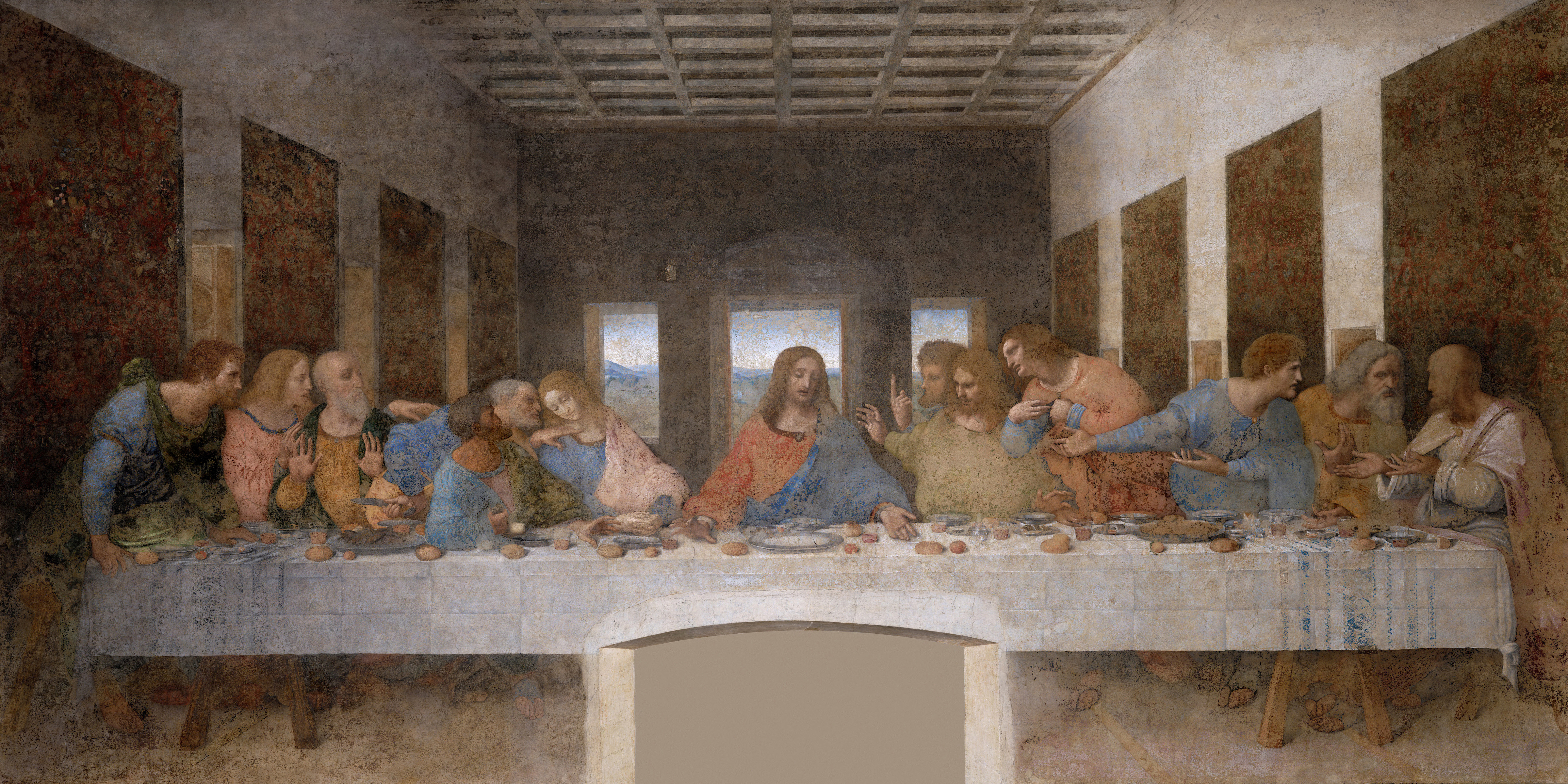 Leonardo da Vinci, The Last Supper, 1495-98
Reading the Object
Narrating a story unfolds via agreed-upon symbols in a specific society. That is why art language is accessible only to those who have socialized in the same cultural space, experienced the same influences of images and ideas as the author. For example, societies where Western culture is integrated into the school program, even in a fragmentary form, are introduced to the source texts, full of ancient symbols. Based on these symbols, it is easy to recognize Sandro Botticelli’s Nascita di Venere [The Birth of Venus] or Leonardo da Vinci’s Ultima Cena [The Last Supper]. It is common in the arts for symbols to overlap each other, and thus, their incorrect deconstruction leads the viewer to make a mistake. There is irony to the fact that even art historians are not exempt from making such mistakes. Distinguishing between the two mythical figures, Judith and Salome, has long been a conundrum for specialists. In both instances, the symbol associated is a severed head, which in one case belongs to John the Baptist, and in the other to the Assyrian general, Halofernes. Observation of the symbols and specialized research becomes a must in distinguishing the figures.
It is worth mentioning that symbols articulated in a society develop mental schemas. By means of them, information is classified and named. Through them, authors visualize topical events of current times. Mental schemas operate on a collective level and help mend the time-spatial separation of events. Symbol becomes the ultimate connecting thread between pre-existing images and events of the present. It shifts the viewer's mind to a specific narrative and speaks in a cryptic language. This method is especially often exercised in totalitarian societies, where art is censored and authors are unable to express their ideas openly and directly.
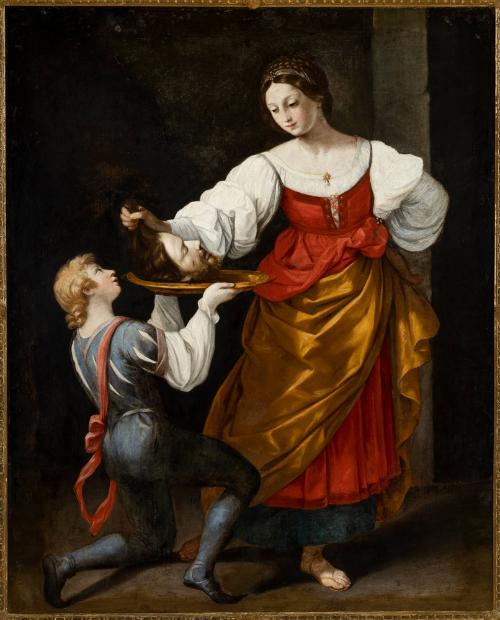
workshop of Guido Reni, Salome Receiving the Head of John the Baptist, ca. 1639-42
Transformation of Objects in Time
The process of reading an image comes with limits, and admitting to this is essential in deconstructing the art and understanding the psychological factors associated with it. Arti is not static. It follows different perceptions and ideas as the times change. In antiquity, the goal of artists was to strive for beauty and harmony and to represent an object in its utmost realistic form. Due to the existence of such an ideal, Ancient Greek authors were in constant efforts to compete with Chronos by creating eternal objects in the linear flow of time so that future people would be able to admire their perfection. (Art historians may have a different opinion on this topic.) Thus were born Scopas’s Maenad, Myron’s Discus Thrower, and Praxiteles’ Aphrodite. The icons created in Ancient Greece long lingered in the minds of the artists of succeeding epochs. The Middle Ages reconceptualized them and reimagined classical figures and motifs in a new light. To preserve the borrowed beauty from the ancient world, artists of this period took a stand against Catholic dogmatism. If, for one part of the humanities, this period is “dark” and “cruel”, art history is looking for light indeed here, at the axis of the man of the world. These visual representations were followed by the emergence of classical and romantic images, the appearance of everyday life, and commonfolk in the pictures. The fall of old idols brought experimentation, avant-garde art, and post-modernism.
Such periodisation of art history, similar to time and space, is a relative concept subject to agreement. Our discussion of world history is skewed, since there is no universal human history; the West is not the center of it, nor is the East its periphery. Our knowledge is determined and dismisses the discoveries made by unique civilizations in other geographical areas. Probably, the number of people aware of the images circulating in the works of Eastern artists can be counted on one hand; the unique schemas produced by their psyche, and how these schemas arranged the perceptions of the world into mental images. As we escape the trap of Eurocentrism, we discover that art speaks different languages, taking on unique forms and styles among different people. This is why Chinese and Dutch painters represent similar objects using idiosyncratic colors, lines, and shapes. There is nothing in common - neither the nature nor the figures. As we already mentioned, the utmost illusion of art lies in its psychological and cultural dimension. The authors' worldview focuses on different ideas, which is why it speaks differently and is accessible only to those who socialize in the same surroundings and resort to familiar reservoirs of culture to deconstruct images.
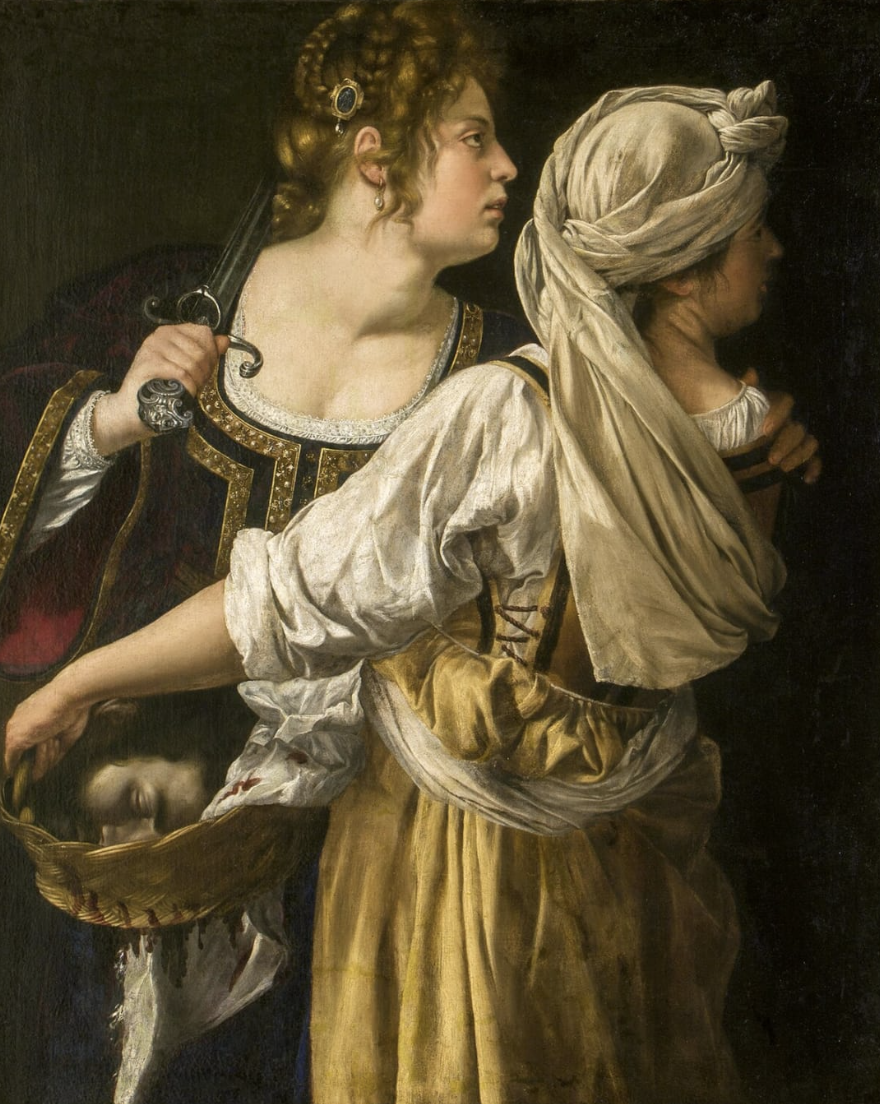
Artemisia Gentileschi, Judith and Her Maidservant, 1618-19
Contemporary Art in Search of Object and Author
Artists have their own perceptions of events occurring in nature and society. These perceptions organize the artistic world in their consciousness and give rise to different mental images, which conceptualize, visualize, and pave their way in the social sphere. The interrelation of art and psychology can be optimized for activating inspiration and the creative process. I will conclude this analytical essay with a few recommendations, which might become a stimulus in the process of perceiving and representing objects.
“Aret requires sacrifice and suffering” has become a thesis of the past. Contemporary artists more often than not visit psychotherapists' offices to gain mental solidity and overcome creative blocks. The first step in a therapy consultation is the realisation of the inner state. The first step is to give a name to current sensations - why is going on here and now, and what does it relate to? Therapy involves identifying behavioral and emotional barriers and searching for ways to overcome them. This process renews the discovery of mental images, their conceptual processing, and visualization.
The stimuli to begin work might come from multiple sources. An important resource for inspiration to arise is the fears, desires, and dreams stored in the subconscious. Releasing and shining light onto them birth specific concepts and visuals. Often, art acts as a mirror, aiding the artist to take a long look at the depths of the psyche and recognize their object.
As art historians say, the main characteristic of postmodernism is its multifacetedness. The same technique is used in a psychotherapist’s office. An artist can conduct a dialogue with themselves, observe the object from different points of identity, and then attempt to form a unified perception of it. In this process, one might encounter the key to an artistic dilemma as well as the way to solve an internal conflict.
When studying the psychic world, it becomes clear that meanings do not exist on their own. They are created by agreement on perception with oneself and the social world. All meanings that enter consciousness at a particular moment are connected to current processes taking place in the inner world. The same can be said about the image and symbols that enter the mind of the artist. At this point, the main task is to articulate symbols and convey them to the viewer. A strong artistic inspiration can cause great frustration.
Visualizing the mental images composed in the mind requires a huge effort. A brush continuously corrects the canvas to make the stroke mirror the mental image; the artist should feel the destruction of bounds in this process and overcome perfectionism, which is one of the important barriers for authors who come to therapy. To break this vicious cycle, therapy replaces unrealistic expectations with healthy and rational ones. As a result, frustration levels go down.
The fear of criticism, doubts, and uncertainty often accompanies the process, especially in the beginning stage. Art requires courage to stand in front of an audience and speak to it. An artist should be ready for the dialogue not to be linear and one-sided. The picture will tell a different story for each viewer. Each viewer will find their own story in the picture.
Exhaustion and burnout are a natural part of the artistic process. Elongated periods of work often lead to draining resources. This state is followed by mental vulnerability and negative thoughts, ranging from unpleasant thoughts to suicidal ideations. It may manifest in a somatic form and affect various areas of the body. Restoring energy begins with acknowledging one's own condition. At this time, it is optimal to terminate the work process and start caring for mental hygiene: engaging in relaxing and pleasant activities. Depending on individual preferences, this can be connecting with nature, yoga, meditation, communicating with close friends, distancing from the information field, etc. The restoration of energy will be accompanied by the revival of an old image, or the emergence of a new one, which will also indicate that the artistic process is returning to its old tracks.
Akaki Burkadze (b. 1989) holds a Doctorate in Psychiatry, a Master’s degree in Healthcare Management, and a European accreditation in Psychotherapy. He is a visiting lecturer at Tbilisi State Medical University. Alongside his academic and clinical work, Akaki is actively involved in both local and international scientific research. Additionally, he is a member of a legislative review group, an expert with the National Democratic Institute (NDI), and an author of policy recommendations in the field of psychiatry.