

 View larger
Tamar Shavgulidze: ‘Resistance’ of David Natidze as an example of the visual connotation of public space
= More info =
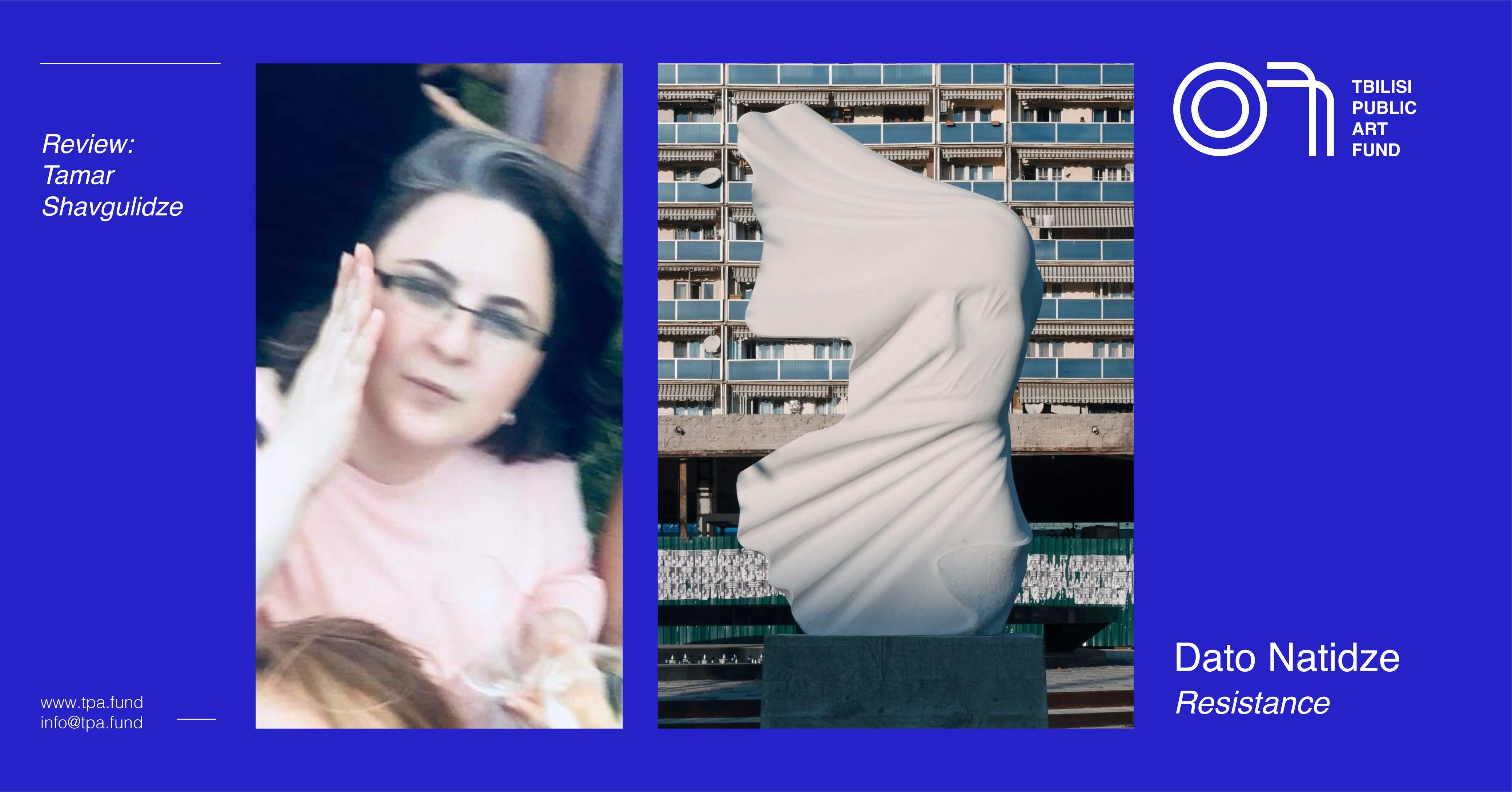
‘Resistance’ of David Natidze as an example of the visual connotation of public space
Tamta Tamara Shavgulidze
Art historian, curator
Doctor of Art History
Assistant professor at the Tbilisi State Academy of Arts
In contemporary Georgia, especially in Tbilisi, over the last decades, the structure of the urban fabric, with its visual constituents diversifying, has become significantly complex, resulting in the overload of the city’s informative and value field. The change in the urban environment, the emergence of new architectural and artistic forms, in the first place, competes with the figurative sculpture, executed in traditional solid material, in a public space. For the conventional sculpture in public space, processes are elemental, changes – time-dictated, and naturally, inevitable. Against the backdrop of the above-mentioned processes, for supporters of the conventional sculptural line, it is particularly pleasant to learn that by the decision of the competition committee of Tbilisi Public Art Fund, in one of the competitions announced in 2023, namely, 'Promotion of permanent projects in public space', a conventional sculptural vision was awarded.
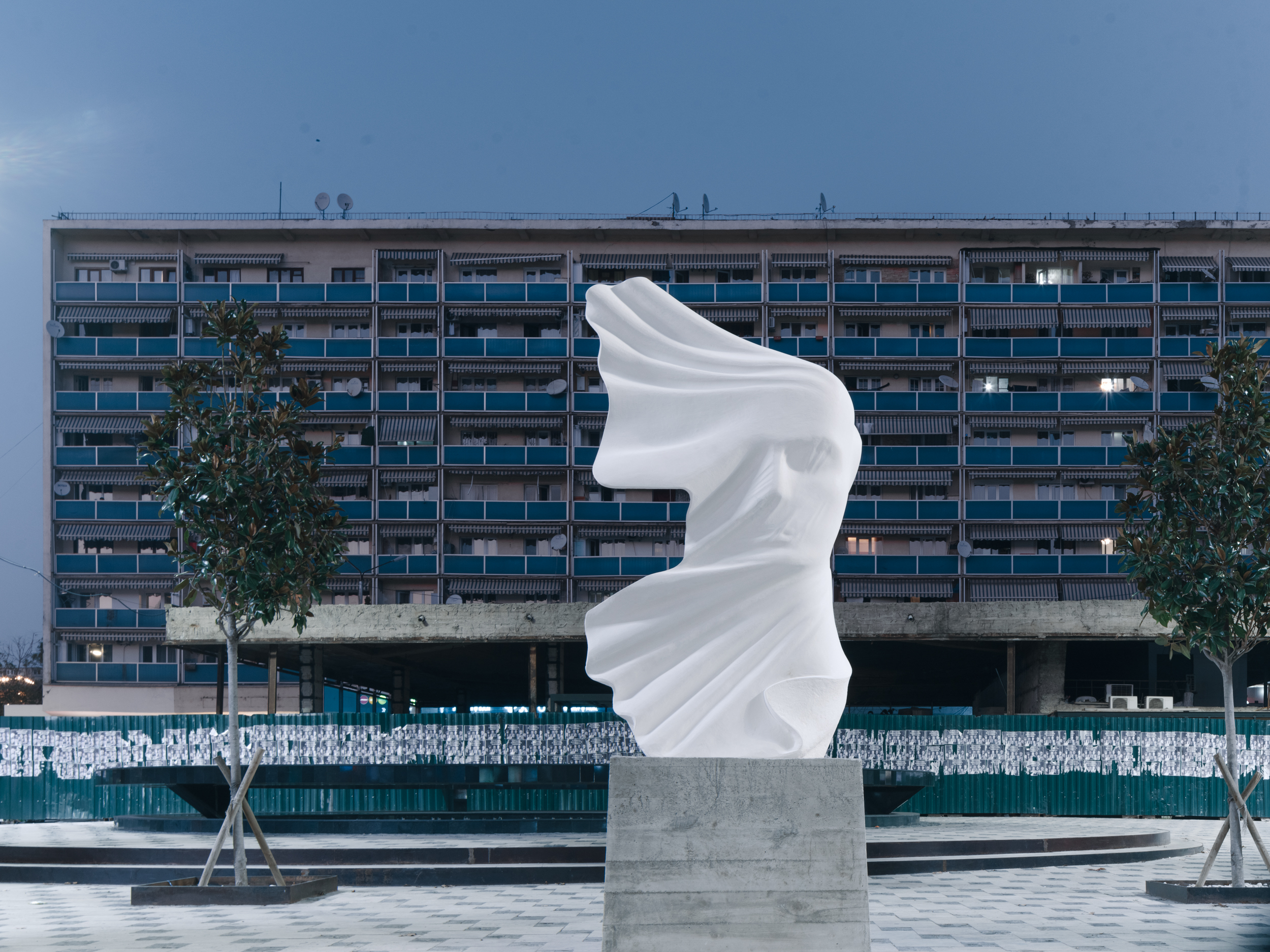
Resistance, 2023, David Natidze
The author of the winning project is an alumnus of the Tbilisi State Academy of Arts, Belgian-based Georgian sculptor, David Natidze. In the framework of the proposed project, he created the sculpture ‘Resistance’, 2023, installed the same year in Avlabari Square.
David Natidze’s sculpture has entered a historically formed public space, touching upon not only the topos of its locational basis, but also giving relevance to the historical context of the entire city, with its historical, memorial, and current informational field. To determine the value of the sculpture ‘Resistance’, it is essential that the line of history of Tbilisi’s public space be described, its transformative face and continuation manifesting in the sculpture of David Natidze.
Sculpture in Tbilisi public art, as a civilizing force and a conduit for political messages, has a 160-year tradition, dating back to the 19th century and encompassing several political and cultural epochs. The earliest and initial stage parallels the epoch of the Russian Empire’s domination. At this time, politics and the cultural alignment of the monuments erected in the city acquiesce (monuments of Russian political figures and Russian cultural practitioners). In both cases, the empire confirms the fact of its political and cultural domination over Georgian territory. During this period, the cultural dynamic reflected in the sculpture of Tbilisi makes apparent the fact that public space, through sculpture indeed, is monopolized by Tsarist Russia, and the Georgian culture behind the facades has ‘emigrated’ to private spaces, again attested by sculpture. Right at that, in Tbilisi and other large Georgian cities, interest in easel sculpture is surfacing. In many 19th-century Georgian families, one could come across sculptural portraits of Georgian writers by Georgian sculptors, privately commissioned by citizens. Exhibiting works of Georgian easel sculpture in homes, while the Russian Empire raged outside, for Georgians, almost equated to the secret signs of the first Christians, as a means of letting each other know they possessed the common Georgian belonging, distanced from Russia.
Dedaena, 1983, Nodar Mgaloblishvili, Elguja Amashukeli
The next stage of Georgian sovietization begins and lasts till the 90s of the 20th century. The aforementioned period in the political and timely frameworks is placed under the political "jurisdiction" of the Soviet Union; however, the sculpture of Tbilisi's public space makes it evident that, from a cultural perspective, there is a characteristic difference between the messages of monuments erected in the 1920s-1950s and those erected in the 1960s. Since the 1920s, statues were installed aimed at creating a common value field for the Soviet peoples, newly created, common historical symbols of the peoples part of the Soviet Union: statues of revolutionaries, memorial objects of World War II, sculptural complexes and monuments, monumental statues of leaders. By the 1960s, said monuments were gradually replaced, or the statues depicting the history (images of kings), identity, and cultural codes (Statue of Dedaena, Statue of Kartlis Deda) of the Georgian nation found an immensely larger space for existence.
Every nation has its glory days, in relation to which it shall recognize itself. The age of glory is usually the age of the paramountcy of saints and heroes. From the 1960s to the 1990s, our process of self-analyzing took place precisely in relation to heroes employing public space, and sculpture, as the most potent visual dominant in it, next to Architecture.
During the Soviet Period, such reinforcement of national narrative in urban space, of course, carried many undesired political undertones; however, today we will not discuss this topic. In the context of this article, it is important to note that from the 1960s to the 1990s, Georgian sculpture enhanced the narrative of national identity through heroes and cultural codes, and prepared the ground for the 1990s. The Perestroika period was marked by political changes and the reinstating of the Georgian Church in the public sphere, which naturally advanced us to the next step of self-identification, signified by the myriad sculptural portrayals of saints in Tbilisi. Practically, throughout the 19th and 20th centuries, Georgian sculpture was the medium in which the triad of our national identity was subsequently visualized: language, homeland, and faith.
From 2003, public space politics in Georgia changed radically. In preceding epochs, the decentralization of the territory demarcated as the common Georgian space began; the discourse in monumental sculpture manifested by Georgians, which upheld the sense of dominance of its history and culture in the nation, turned into an unexpected phantom.
.jpg)
Citizens, 2006, Gia Japaridze
The entire emphasis was placed on several types of new monuments, or to be more exact, sculptures. Indeed, monuments stepped down from pedestals and merely retained the status of urban sculpture. The first type of monuments served as symbolic and visual touchstones of the new political force that came to power in 2003. The political, cultural, and value intentions of the ruling power were confessed through them, the most striking example of this being the Monument of Prometheus (sculptor D. Khmaladze, 2007). The second type of monuments, rather, emancipate the public space - charged and conditioned by the societal memory and ethno-historic narrative - from the burden of national signs and a kind of imperative reverberance, alleviate and soften the pathetic tone of Georgian historicism and religious feelings in space, and introduce the ligness of being and political irony. This order of sculpture comprises the sculptural group on the N. Baratashvili Bridge, ‘Citizens’ (sculptor Gia Japaridze, 2006), small figures erected on Shota Rustaveli Avenue (sculptor L. Bujiashvili, 2010), Tbilisian ‘Lamplighter’ on N. Baratashvili Street (sculptor I. Tsuladze, 2004), ‘New Wave’ (sculptor I. Tsuladze), ‘Bicycle’ (sculptor J. Dupas, 2011), etc. In the first decade of the 21st century, to fully register the political changes of Georgian urban public space, the precedents set since 2003 must be duly noted, as they are equally political gestures implemented through a sculpture of public space: relocation of the Monument to David the Builder (sculptor, M. Berdzenishvili, 1997) from the central Tbilisi location of First Republic Square; The explosion of the Glory Memorial (M. Berdzenishvili, 1982) in Kutaisi and others.
Bicycle, 2011, J.Dupas
Despite the qualitative alterations in the politics of public space, from the 2010s to the present, the tradition of erecting monuments of memorial impetus and sculptural portraits has continued. In recent decades, the Tbilisi City Hall has revived the tradition of conducting competitions for monumental sculptures to be placed in public spaces. As a result, compared to the last decades, we see examples of much better thought-out policies in regard to urban space and sculpture in public space. It is clear that the chief objective of public sculpture is well comprehended -to encourage the process of transformation/correction of preexisting cultural patterns in the local society, or to fill the space with new denominators of value. Institutions are primarily behind the ongoing process regarding monumental sculptures in public spaces, taking the role of a commissioner and thus, contentual and conceptual shaper of public space. They bear responsibility for both the success and failure of the implemented changes. Alongside artists, they create and form cultural spaces in the city and imbue them with content.
In light of the above, the precedent of erecting the statue of David Natidze (‘Resistance’) becomes particularly interesting. I will repeat myself and state that installing a sculptural project in the city, executed in a traditional sculptural form, is, in itself, of special significance. As we see it, the key message of the sculpture is of even greater importance - resistance, which stands for the attempt to charge the city space with new substance. At first glance, it seems that we are returning to heroes and heroics again, the abundance of which marked the 1960s’ Tbilisi public space, but the new heroism proposed by D. Natidze is subjectively different from past models, which adds a special value to the Sculpture ‘Resistance’.
Depicted heroism implies an ordinary citizen. David Natidze’s heroism has no face of a concrete historic figure; thus, it is not bound by any historic persona or past. It is equally present in all three divisions of time and portrays already born, currently living, and in the future, a hero that is yet to enter the arena, or rather, an archetype of a hero.
The emotional center of the sculptural composition is the tension arising at the boundary of masses and movements pulling in different directions; The composition’s visual center is blown, a face slowly lifted from the draped, white fabric stands firm in the wind gusting around it. Besides, the wind also has a dual meaning; on the one hand, it indicates the physical and moral solidity of the hero, and on the other hand, it fully fits into Aby Warburg's so-called "pathos formula," which gathers utmost emotionally charged, easily recognizable visual patterns traveling across time and cultures that are scattered across art history of different eras. The trope of wind and blowing fabric is one of such often encountered itinerant patterns, but what is interesting to us is the line that is rooted in ancient Greece and eventually finds its way into our most recent Soviet past. In both cultures, the sculptural visualization of the wind in blowing fabric heightens heroic sensibilities, alludes to the hero's valor, and partly reflects the supernatural backing the hero possesses. The same is true of the statue of David Natidze – using an inherited visual formula familiar to Georgian society, it revealed the process of the birth of a new hero.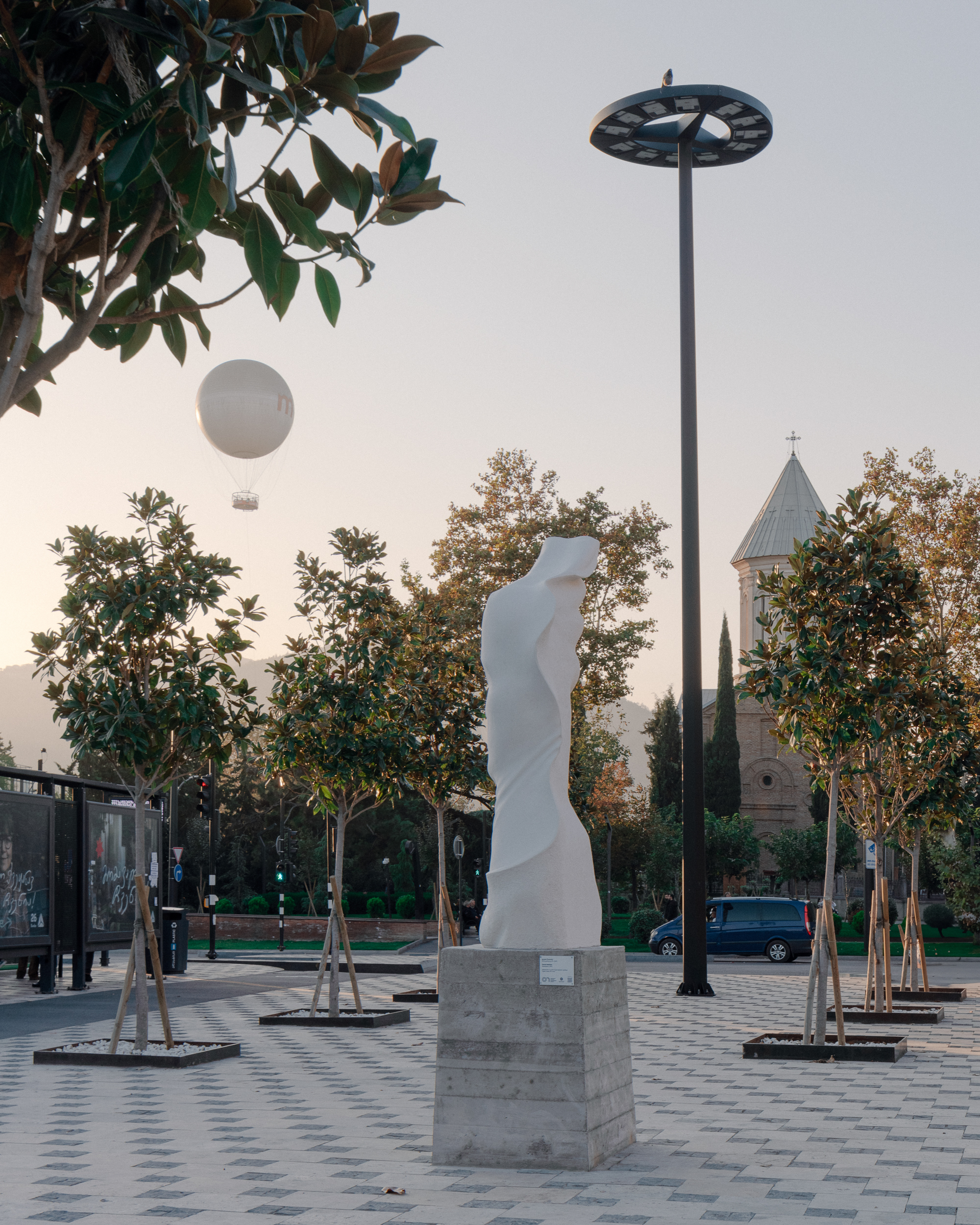
Resistance, 2023, David Natidze
David Natidze’s ‘Resistance’ is a city-specific work. The sculpture was from the get-go designed for Avlabari Square. The work stands out with its representative nature, following the traditional line of Tbilisian sculpture established by Elguja Amashukeli, marked by emblematic sculpture. ‘Resistance’ is categorized as emblematic sculpture due to its specificity of form and mass distribution, and the planar contour finesse.
From different angles, the sculpture creates a sharp contrast with the surrounding architectural landscape, particularly with such a meta-visual object that is the example of the dominant Soviet architecture of Avlabari Square. Despite this, the sculptural form is in harmony with the space, at the expense of which the contrast with the environment is maintained, which, in turn, is sharp, but so moderate that it does not pose a threat to the full, spatial display of the sculptural form.
‘Resistance’ is partially context-specific as well, since Avlabari, as a topos, has its history of waves of resistance. As thought David Natidze's sculpture brought the history of Soviet-era uprising and resistance back into the fold of a unified history, simultaneously emphasizing the role of this square in the history of Tbilisi protests over the past century. Through this sculpture, the time and space of acceptable and unacceptable epochs of Georgian history merged. The sculpture is not critical and without any judgment, it brings all types of resistance, past, current, or future, to the attention of the viewer, which clarifies that for David Natidze, the role of the sculpture and sculptor is limited to visual commentary, and he entrusts the viewer with the judgment.
As a final point, the author of the text should clarify that the context of David Natidze's sculpture is not determined solely by Avlabari as a topos. ‘Resistance’ is an object determined by time as well, as it reflects the idea of resistance, which no one side should monopolize in time and space. The sculpture reflects the idea of resistance as a valuable event in itself, as part of the citizens' rights, as a testimony to the existence of civil society, and a monument to the citizen, which only recently has come to the forefront in our history, soon became a participant in the process of creating history, and the voice of which was heard loudly and resoundingly in the present.
In the country’s history, the face of a previously silent citizen, as the sculpture ‘Resistance’ gradually carves out in stone before the viewer, is a monument to the values of contemporary society and the continuation of our journey in search of identity in the sculpture, which began in the 19th century.